

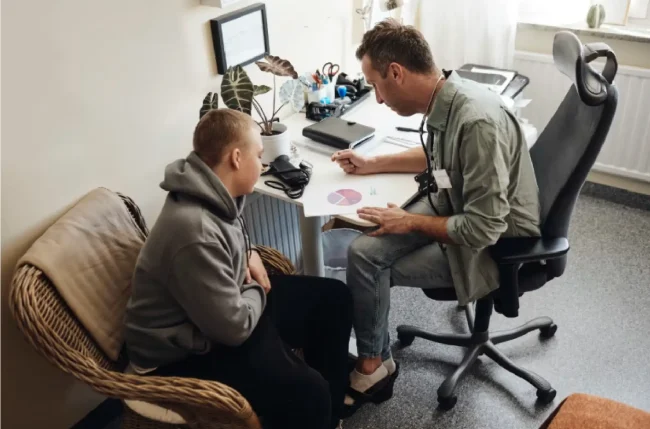
American schools have quietly transformed into pseudo-psychiatric clinics.
Schools are now the most common provider of youth mental-health services in the U.S. More kids get mental-health care at school than in any other clinical setting. The ubiquity might have parents assuming school services are high-quality, well-regulated and effective. They’d be wrong on all counts.
What passes for mental-health care in schools is mostly superficial, like screening kids if they worry but don’t know why—or, more ominously, if they’ve considered how they’d kill themselves. What’s not formal screening is typically pseudo-screening—mental-health awareness campaigns, educating all students and teachers how to screen themselves and each other for signs of distress.
A healthy student needs only to check a survey box to be funneled by teachers and school staff toward a clinician for a diagnosis and a pill. Parents are meant to be engaged, but minor age consent laws are often lower for mental health—12 in some states, and younger in others if a counselor thinks a student is mature.
These programs don’t work. Rigorous evaluations find no mental-health or academic benefits gained from universal screening and other prevention programs in schools. But false positive rates can be as high as 97%. That means, based on the prevalence of serious conditions, for every one student correctly identified, around 10 others are mislabeled as potentially mentally ill.
The 1 in 10? They aren’t kids who’d otherwise get missed.
For the serious cases, shallow school intervention fails spectacularly. Take Oxford High School in Oxford, Mich., where a student killed four classmates in 2021. The district had invested heavily in mental-health screening software and hired additional staff. The student-shooter had been flagged “high-risk” for years. Teachers reported him for viewing images of guns and bullets. The morning of the attack, staff discovered disturbing drawings he’d made about blood and death. The school counselor simply sent him back to class. No backpack search. No safety plan. Hours later, four kids were dead.
Parents, understandably, want transparency and consent over what happens to their children. But parental consent in school mental health is imaginary.
There’s no systematic tracking of compliance at any level—local, state or federal. One example: New York City funds a free mental-health app called Teenspace that surveys teens for treatment. I filed a public records request asking the city how many minors received treatment without parental consent. Their response: They have no record. Nationally, three-quarters of school counselors admit giving surveys without parental consent.
School professionals, meanwhile, are in an impossible position. They’re asked to do far more than their training has prepared them for, in part because they’re overseen by authorities with no mental-health expertise. Teachers aren’t diagnosticians. School counselors and psychologists don’t need to be licensed to provide mental-health care, as their clinical counterparts are. They’re credentialed by education departments and supervised by school administrators. Are parents aware?
Teachers, parents and school administrators aren’t clear on counselors’ and school psychologists’ roles. No one should be providing therapy. But that’s what’s happening. The result? Kids who don’t need treatment get it. Kids who genuinely need help get lost in the noise.
Original Source
https://www.wsj.com/opinion/free-expression/a-school-isnt-a-psychiatric-clinic-e25ead42?st=17modg&reflink=desktopwebshare_permalink