U.S. public schools lost 1.2 million students to private and charter schools and homeschooling in the first two years after the COVID-19 pandemic. In September 2023, U.S. Secretary of Education Miguel Cardona declared: “Public schools are approaching a ‘make or break’ moment.”
In Texas, for example, public schools reported a 2.9% enrollment decline for the 2021-22 school year, while the state’s charter schools saw an 8.6% increase, according to the National Alliance for Public Charter Schools.
Many kindergarten through 12th grade (K-12) public school leaders believe sport programs can stem enrollment declines by engaging students and families and galvanizing communities. As one leader stated: “Our community really values sports. We are going ‘all in’ on sports. It’s the best way to attract families traumatized by COVID-19.”
Research shows that physical activity has a small and positive association with academic achievement. Seizing on such results, school and district leaders have become increasingly fixated on sports as a way to ameliorate academic underperformance. But is prioritizing sports over academics a panacea for boosting enrollment?
To answer this question, K-12 school leaders must account for the views of their most critical stakeholders: parents who entrust their children to their districts. A customer-focused strategy enables educational institutions to identify the customer needs providing the most value to parents, align strategy execution to those needs, and ultimately improve customer loyalty and academic outcomes. Without a clear understanding of parents’ value drivers, school district
strategies miss the mark, leading to declining enrollment and academic achievement.

Since 2022, the Stratonomics-K12™ Strategy Science Study
has measured parents’ beliefs and attitudes about, as well as satisfaction with, their child’s education. The ongoing study measures parent satisfaction with different dimensions of K-12 education, along with their agreement with various statements about the school experience.
The report focuses on parents’ perceptions of the relative
importance of sports versus academics in schools. The results
are based on responses from 17,700 parents of children in
grades K through 12.
Stratonomics-K12 measures parents’ beliefs and attitudes about, and satisfaction with their child’s education.
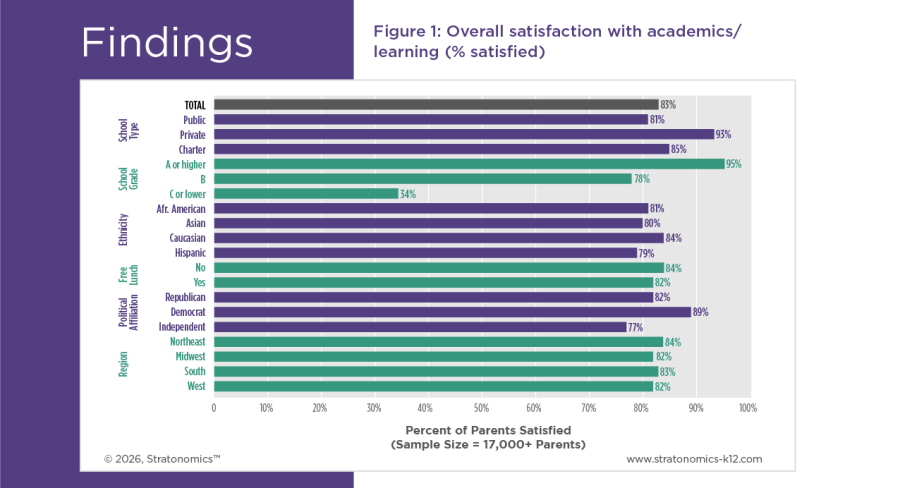
As shown in Figure 1, most parents (83%) are satisfied with the academics/learning at their children’s school. Furthermore:
• Satisfaction is strongest among parents of students in private schools and schools the parents grade A or higher. Satisfaction is weakest among parents who grade their school C or lower.
• Democrats are more inclined to be satisfied than Republicans or Independents.
• The level of satisfaction does not vary substantially by ethnicity.
• Parent satisfaction is similar regardless of whether the child has access to free/reduced lunch.
• Region is not a major factor influencing satisfaction.
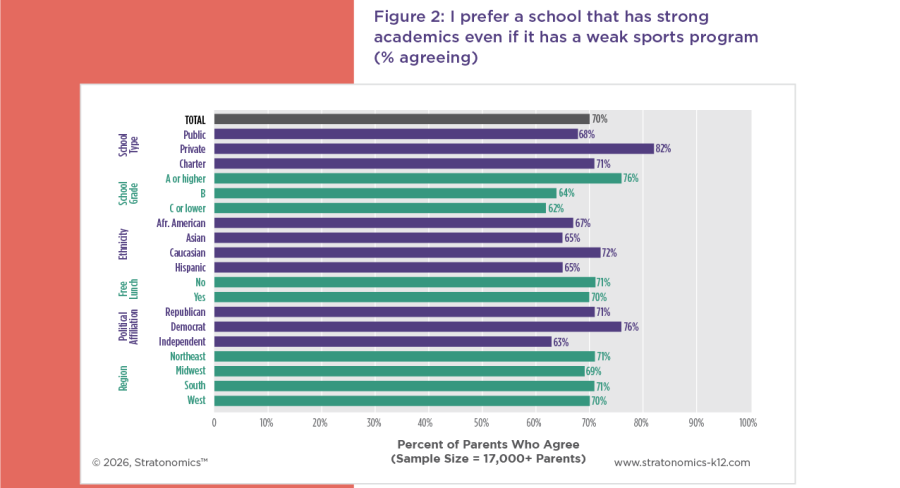
As shown in Figure 2, most parents (70%) agree that they prefer a school that has strong academics even if it has a weak sports program. Furthermore:
• Agreement is strongest among parents of students in private schools and in schools the parents grade A or higher.
• Caucasians are more likely to agree than other ethnicities.
• Democrats agree somewhat more than Republicans and a great deal more than Independents.
• Agreement does not vary significantly among parents based on their student’s access to free/reduced lunch.
• Region is not a major factor affecting agreement level.
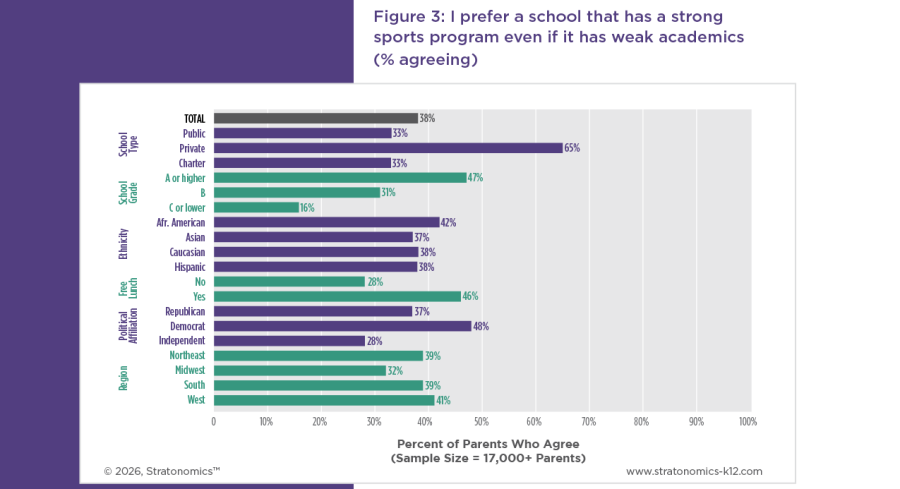
As shown in Figure 3, few parents (38%) agree that they prefer a school that has a strong sports program even if it has weak academics. Furthermore:
• Parents of students in private schools most strongly agree.
• Parents grading their school A or higher agree to a greater extent than those grading their school B or lower; however, less than half who grade their school A or higher prefer sports over academics.
• No major differences emerge based on ethnicity.
• Agreement is strongest among parents whose students have access to free/reduced lunch.
• Democrats agree more consistently than Republicans and Independents.
• Parents in the Midwest are least likely to agree.
Key takeaways from the Stratonomics-K12™ Strategy Science Study include:
Most parents are satisfied with the academics/learning at their child’s school and believe academics are more important than sports programs.
Insights from this report can inform school districts regarding the importance of a strong sports program in schools. The report shows that strong academics are critical and should not be comprised by committing too many resources to sports programs.
Mittal, Vikas (2026), “Do Parents Prioritize Sports or Academics in K-12 Education?,” Stratonomics-K12™ Strategy Science Study, 1-9.