© 2026 by StratonomicsTM . This document is licensed to be used only by permission from Stratonomics-K12TM . All information shared is copyrighted, proprietary, and confidential. Do not copy, record, share, store, distribute, use in language or learning models, modify content, use for teaching purposes without full attribution, assign as reading, transmit, or otherwise use in any capacity (e.g., corporate presentations or strategy planning) without express written permission and full attribution. Contact info@stratonomics.inc for rights and permissions.

www.stratonomics-k12.com

Stratonomics-K12TM Strategy Science Study

industry insights assets k12-pt2-24

Stratonomics-K12TM Strategy Science Study

Background

Leaders of kindergarten through 12th grade (K12) institutions often wonder who should get credit for a student’s success or failure in school. Should it be students, teachers, or parents? Research shows all three are critical.

Regarding parents, a meta-analysis of 37 studies examining K12 education showed parental involvement is positively associated with academic achievement, with especially strong links for academic expectations and constructive communication.

In terms of teachers, a study using administrative and tax records of more than 1 million children showed that students assigned to high value-added teachers are more likely to attend college, earn higher salaries, and have fewer teen births than their peers—effects that persist into adulthood. Specifically, replacing a teacher ranked in the lowest 5% with an average teacher increases students’ lifetime income by more than a $250,000 per classroom.

Students also contribute to their own positive outcomes. Specifically, a meta-analysis of 58 studies showed that students using different learning strategies achieve varied degrees of success.

From a strategy planning perspective, it is important for K12 leaders to understand the views of the most critical stakeholder in schools: parents who entrust their children to their districts.

Specifically, we want to know to what extent parents attribute their child’s success to teachers, students, or themselves.

Doing so can enable K12 leaders to develop a customer-focused strategy and excel on the customer needs providing the most value to parents, align strategy execution to those needs, and improve customer loyalty and academic outcomes. Without a clear understanding of parents’ value drivers, school district strategies inevitably miss the mark, leading to declining enrollment and academic achievement.


www.stratonomics-k12.com

1

Stratonomics-K12TM Strategy Science Study

Research Methodology

Since 2022, the Stratonomics-K12TM Strategy Science Study has measured parents’ beliefs and attitudes about, as well as satisfaction with, their child’s education. The ongoing study measures parent satisfaction with different dimensions of K-12 education, along with their agreement with various statements about the school experience.

The report focuses on the use and impact of the internet and technology in schools. The results are based on responses from 17,700 parents of children in grades K through 12.

Stratonomics-K12 measures parents’ beliefs and attitudes about their child’s education.

www.stratonomics-k12.com

2

Stratonomics-K12TM Strategy Science Study

industry insights assets k12-pt2-26

www.stratonomics-k12.com

3

Stratonomics-K12TM Strategy Science Study

industry insights assets k12-pt2-27

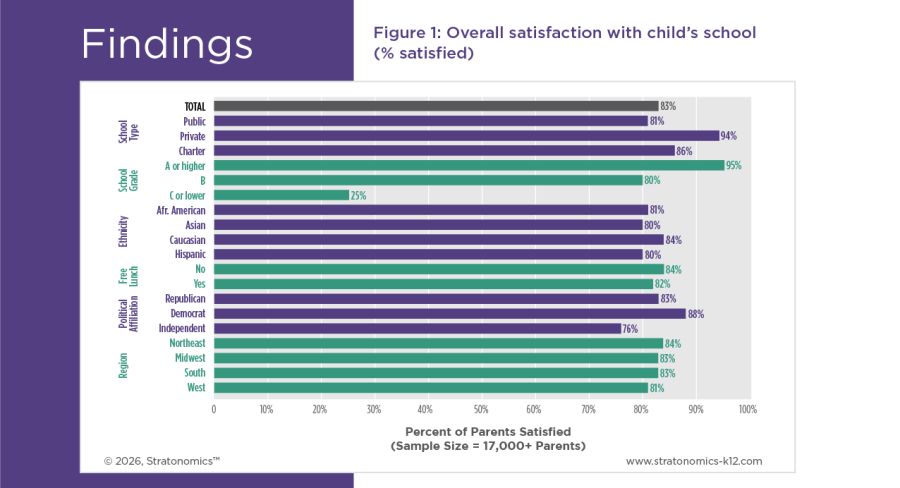
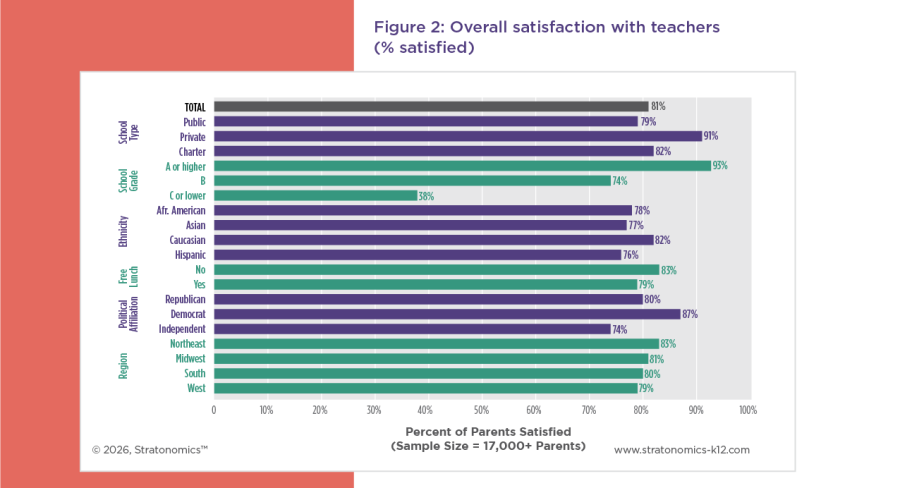
Figures 1 and 2 show parents’ overall satisfaction with their children’s schools and teachers.

As shown in Figure 1, most parents (83%) indicate high
overall satisfaction with [their] child’s school. Furthermore:

  • Satisfaction is strongest among parents of students in private schools and schools graded A or higher.
  • Satisfaction is low among parents grading their school C or lower.
  • Democrats are slightly more satisfied than Republicans and considerably more satisfied than Independents.
  • Ethnicity does not have a major impact on satisfaction.
  • Overall satisfaction with schools is similar regardless of whether the child has access to free/reduced lunch.
  • Region is not a major factor influencing satisfaction.

www.stratonomics-k12.com

4

Stratonomics-K12TM Strategy Science Study

industry insights assets k12-pt2-28

As shown in Figure 2, 82% of parents are satisfied with
the teachers in their children’s schools. Furthermore:

  • Satisfaction with teachers is strongest among parents of students in private schools and schools the parents grade A or higher. Teacher satisfaction is low among parents grading their school C or lower.
  • Caucasian parents are somewhat more satisfied than those identifying with other ethnicities.
  • Democrats are more satisfied than Republicans and Independents.
  • Satisfaction is similar regardless of whether the child has access to free/reduced lunch.
  • Region is not a major factor influencing satisfaction.

www.stratonomics-k12.com

5

Stratonomics-K12TM Strategy Science Study

industry insights assets k12-pt2-29

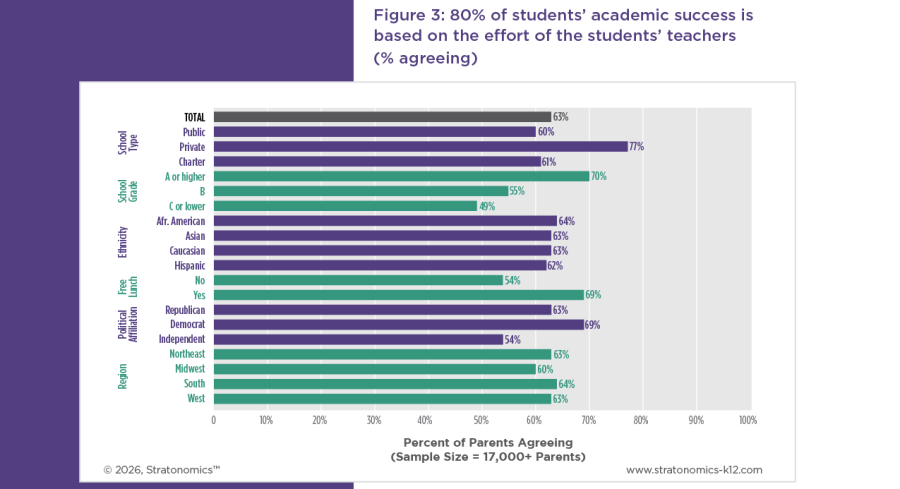
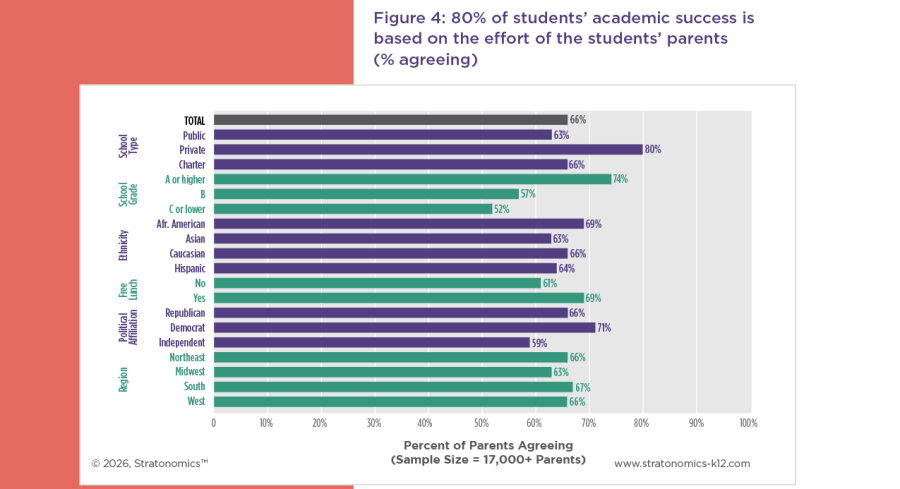
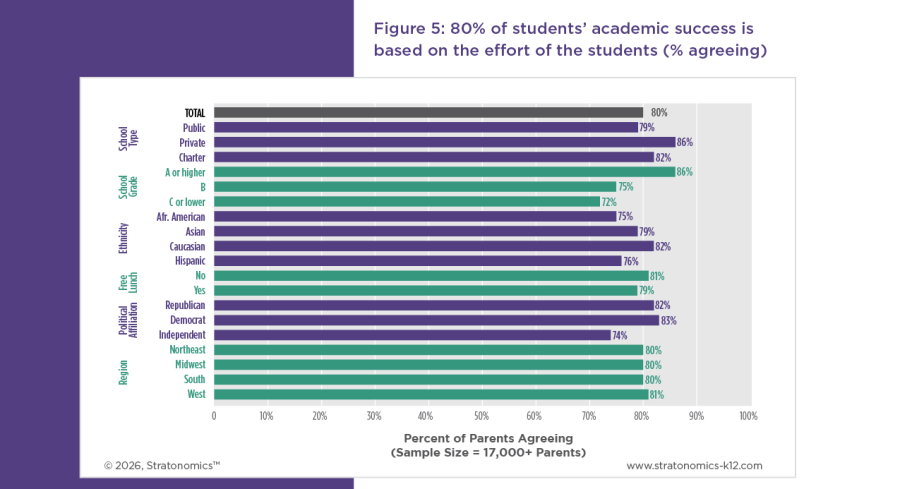
Figures 3, 4, and 5 show parents’ agreement with statements about who should receive credit for students’ academic success.

As shown in Figure 3, more than half of parents (62%)
agree that 80% of students’ academic success is based on
the effort of the students’ teachers. Furthermore:

  • Agreement is stronger among parents of private school students than those of charter or public-school students.
  • Parents grading their child’s school A or higher consistently agree.
  • Parents whose children have access to free/reduced lunch agree more consistently than do parents whose children do not have access.
  • Democrats agree slightly more than Republicans and considerably more than Independents.
  • Ethnicity has little impact on agreement.
  • Agreement does not vary significantly by region.

www.stratonomics-k12.com

6

Stratonomics-K12TM Strategy Science Study

industry insights assets k12-pt2-30

As shown in Figure 4, two thirds of parents (66%) agree
that 80% of students’ academic success is based on the
effort of the students’ parents. Furthermore:

  • Agreement is strongest among parents of students in private schools and those grading their school A or higher.
  • African American parents agree slightly more consistently than those identifying with other ethnicities.
  • Parents of students with access to free/reduced lunch agree more consistently than do parents whose students do not have access.
  • Democrats agree marginally more than Republicans and substantially more than Independents.
  • Satisfaction does not vary by geographic region.

www.stratonomics-k12.com

7

Stratonomics-K12TM Strategy Science Study

industry insights assets k12-pt2-31

Figures 1, 2, 3, and 4 show parents’ agreement with different statements regarding internet access in schools.

As shown in Figure 5, agreement is consistent (80%) that 80% of students’ academic success is based on the effort
of the students. Furthermore:

  • Agreement is consistent across the board, but parents of private school students and those grading their schools A or higher agree most consistently.
  • Caucasian parents agree slightly more than African
    American or Hispanic parents.
  • Access to free/reduced lunch has little impact on agreement.
    • Democrats and Republicans agree similarly.
    • Region has little impact on agreement.

www.stratonomics-k12.com

8

Stratonomics-K12TM Strategy Science Study

Key Takeaways

Key takeaways include:

  • Parents rate their children’s schools favorably overall. They are consistently satisfied with their children’s schools’ teachers; however, they give considerably more credit for students’ success directly to students than to parents or teachers.
  • Most parents (80%) agree that 80% of students’ academic success is based on the effort of the students themselves. Agreement is high across the board, but parents of private school students, those grading their schools A or higher, and Caucasian parents most consistently give credit to students.
  • Far fewer attribute 80% of students’ academic success to teachers (62%) or parents (66%).

Insights from this report can inform school districts on the extent to which parents give credit for students’ academic success to teachers, parents, or students themselves, an important consideration when planning strategy.

www.stratonomics-k12.com

9

Citation

Mittal, Vikas (2026), “Students, Teachers or Parents: Who Should Get Credit for Student Success?” Stratonomics-K12™ Strategy Science Study, 1-11.