
Despite the importance of education in terms of spending and its impact, dissatisfaction with traditional public schools is growing due to students’ underperformance. One reason, among many, is the lack of strategic focus among educational institutions. The authors theoretically and empirically demonstrate the benefits of a customer-focused approach to strategy planning and execution for improving student performance. A customer-focused strategy enables educational institutions to identify customer needs providing the most value to customers, align strategy execution to those needs, and ultimately improve customer loyalty and academic outcomes. We demonstrate the approach using data from qualitative interviews with school leaders and surveys from 10,644 K12 parents. We conclude that a customer-focused approach helps educational institutions satisfy their customers and achieve higher academic outcomes.
“Education is the most powerful weapon which you can use to change the world.”
– Nelson Mandela
The United Nations has included quality education as one of its 17 Sustainable Development Goals (SDGs) that require immediate and collective action from all countries. According to Grewal et al. (2022) “education transforms individuals, households, and societies for the better” in multiple ways: increased income (Morgan & David, 1963), reduced income disparity (Campos et al., 2016), improved health behaviors and outcomes (Cesur et al., 2014; Faeh et al., 2011), higher economic growth (Aghion et al., 2009), more engagement in civic behaviors like voting (Milligan et al., 2004) and skills for employment, entrepreneurship, and self-growth (Filmer et al., 2018).
Nations spend vast resources on education (Unicef, 2020). In 2020, the U.S. spent 6.1 percent of its GDP on education ($1.3 trillion), vastly exceeding sectors like supermarkets, automobiles, and energy.Footnote1 Similarly, China spent 4.2%, India spent 4.6%, and Brazil spent 6% of its GDP on education.Footnote2 Given these vast investments, it is important to assess whether educational institutions, specifically K12 public schools, are strategically prioritizing and utilizing resources to satisfy families to garner higher loyalty and academic outcomes. To answer this question, this article offers a customer-focused framework rooted in the satisfaction performance chain (SPC). This framework utilizes data provided by the Collaborative for Customer-Based Execution and Strategy (C-CUBES™) to identify and prioritize the needs of their primary customers—families and children served—based on each need’s contribution to customer value. The prioritized customer needs enable schools to optimize strategy formulation and execution (Figs. 1, 2, and 3). Using this framework, K12 educational institutions can prioritize initiatives that increase customer satisfaction, customer loyalty, academic outcomes, and financial stability.
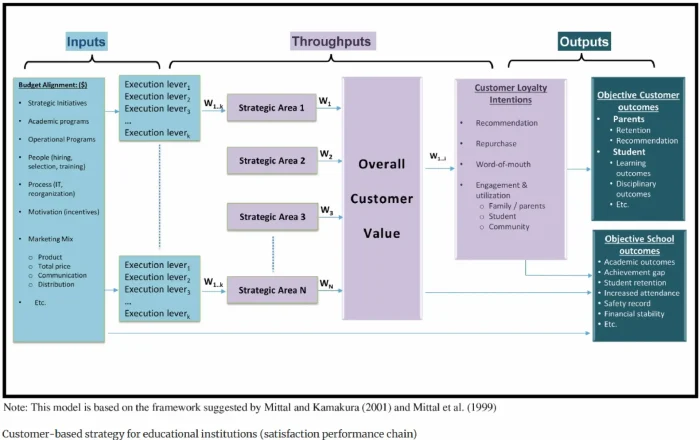
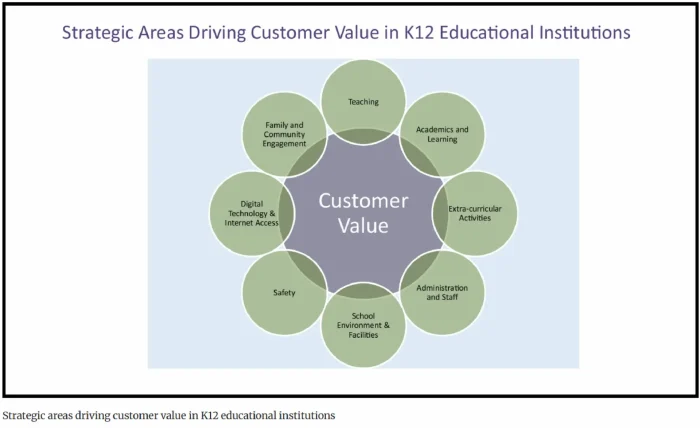
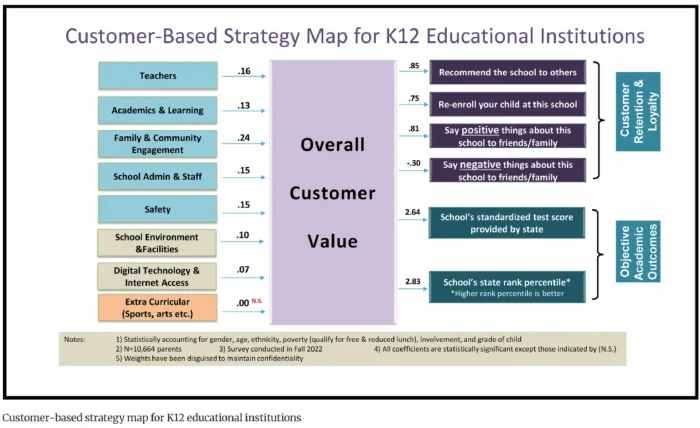
The article utilizes qualitative interviews with more than 150 superintendents, principals, board members, teachers, and staff members at multiple school districts representing more than 1,000 schools and over 1 million K12 students. We also report results from a study where 10,664 family members rated their satisfaction with their child’s school, incorporating this information with school performance data obtained from state records. Using this data from Collaborative for Customer-Based Execution and Strategy (C-CUBES™), we discuss how K12 schools’ strategy planning process can be improved. The customer-based approach is applicable to all educational institutions including private K12 institutions, colleges, universities, and university departments, to name a few. As an example, we also present a higher-education application for a business school at a private university.
Original Source
Mittal, V., Jung, J. Revitalizing educational institutions through customer focus. J. of the Acad. Mark. Sci. 52, 1323–1342 (2024). https://doi.org/10.1007/s11747-024-01007-y