

Approximately
34% of US
teens aged
12-17 report
being bullied.
Centers for Disease Control and
Prevention
Cyberbullying and internet safety have emerged as serious issues for students throughout K-12 settings. Recent data reveal troubling trends:
• According to a Centers For Disease Control and Prevention report, approximately 34% of U.S. teens aged 12-17 report being bullied via physical, verbal, online, or social methods. Among them, roughly 6% are bullied more than once a week, with 7% being bullied monthly. Bullying occurs when individuals are repeatedly exposed to aggressive behavior by one or more people and are unable to defend themselves.
• At public schools, roughly 19% of students aged 12-18 report being bullied during school, and among those, 22% experience bullying by online means, such as texting.
Cyberbullying and internet security are no longer marginal issues. School leaders and district administrators have sought to address the concerns in many ways, offering prevention strategies, developing appropriate policies, training staff, lending mental health support, and creating clear response protocols.
Safeguarding the digital and physical environment is essential not only for student safety, but also for student retention and academic achievement. As reported in the Harvard Business Review, safety is a driver of schools’ strategic success.
To fully appreciate the importance of these issues, it is critical to understand the views of parents, any school’s most critical customers. A customer-focused strategy enables educational institutions to identify the needs providing the most value to parents and their children, align strategy execution with those needs, and improve customer loyalty and academic outcomes. Without a clear understanding of parents’ value drivers, however, school district strategies miss the mark, leading to declining enrollment and academic achievement.
The Stratonomics-K12TM Strategy Science Study has measured parents’ beliefs and attitudes about, as well as satisfaction with, their child’s education since 2022. The ongoing study measures parent satisfaction with different dimensions of K-12 education, along with their agreement with various statements about the school experience.
The report focuses on the use and impact of the internet and technology in schools. The results are based on responses from 17,700 parents of children in grades K through 12.
Stratonomics-K12 measures parents’ beliefs and attitudes about their child’s education.


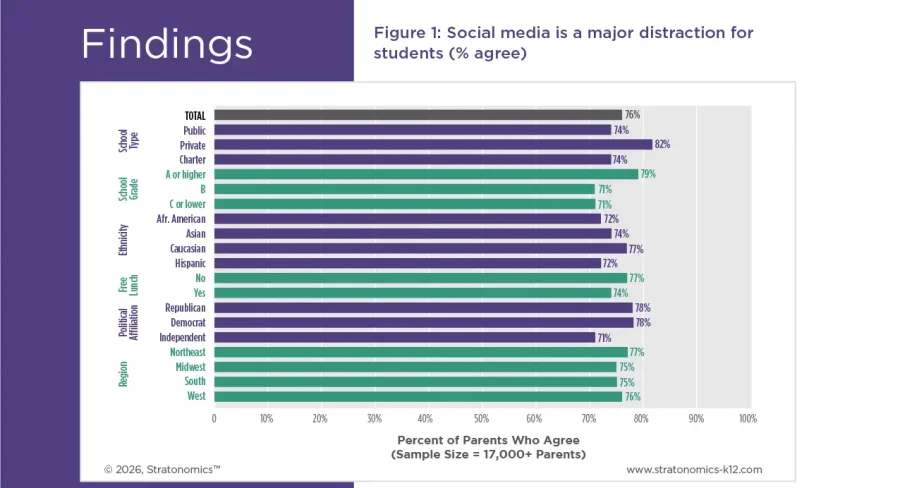
As shown in Figure 1, a large majority of parents (76%) agree that social media is a major distraction for students. Furthermore:
• Agreement that social media is a major distraction for students is strongest among parents of students in private schools and schools graded A or higher.
• Level of agreement does not vary substantially by ethnicity.
• Agreement is similar regardless of whether the child qualifies for free/reduced lunch.
• Political affiliation does not have a major impact on agreement.
• Few differences are noted by region.
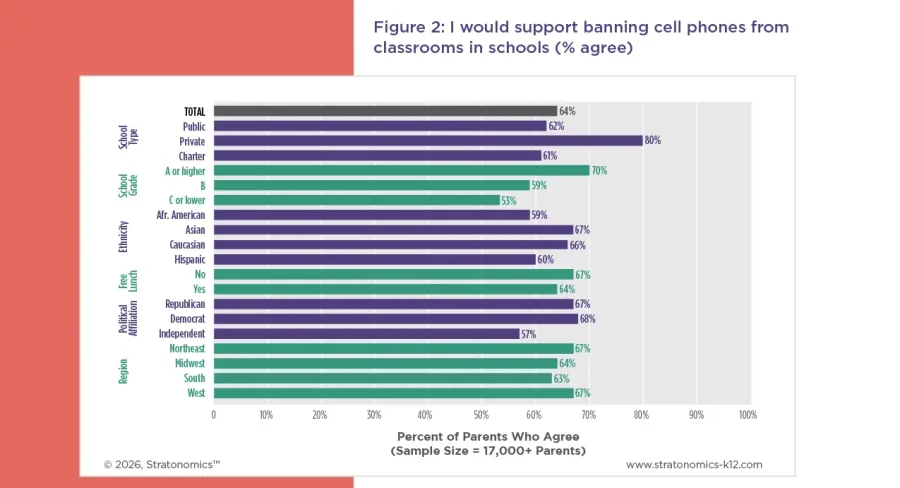
As shown in Figure 2, a majority of parents (64%) agree they would support banning cell phones from classrooms in schools. Furthermore:
• Parents of students in private school and schools graded A or higher are most apt to agree.
• Caucasian and Asian parents support banning cell phones more than parents of African American or Hispanic students.
• Access to free/reduced lunch has little impact on agreement with supporting cell phone bans.
• Democrats and Republicans have similar levels of agreement with supporting cell phone bans in classrooms.
• Few differences are noted by region.
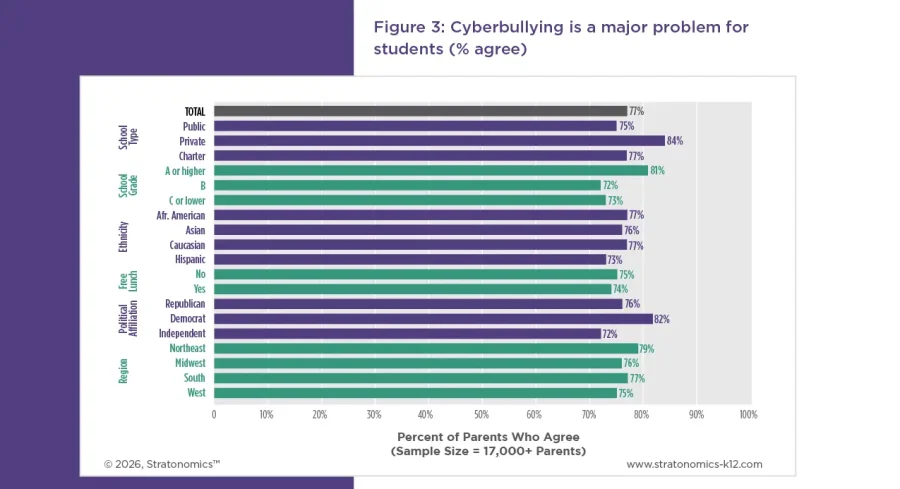
As shown in Figure 3, a majority of parents (77%) agree that cyberbullying is a major problem for students. Furthermore:
• Parents of students in private schools and those grading their schools A or higher more strongly agree that agree that cyberbullying is a major problem for students.
• Democrats agree more strongly than Republicans or Independents that cyber-bullying is a major problem for students.
• Agreement does not vary much by ethnicity.
• Access to free/reduced lunch has little impact on agreement.
• Region is not a key factor in parents’ agreement with the above statement.
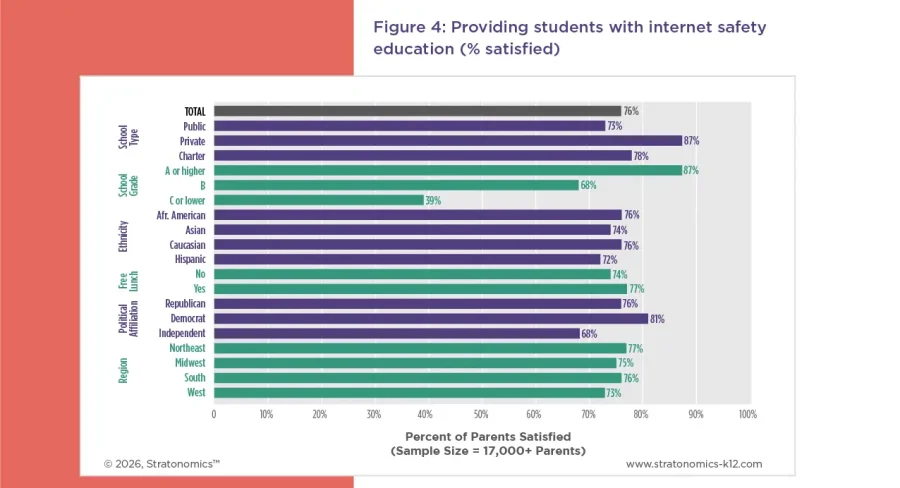
As shown in Figure 4, parents are satisfied (76%) with their schools providing students with internet safety education. Furthermore:
• Satisfaction is strongest among parents of students in private schools and schools they grade A or higher.
• Democrats are more satisfied than Republicans or Independents with their school providing students with internet safety education.
• Only 39% of parents whose children attend schools graded C or lower are satisfied with their school providing internet safety education.
• Little difference in satisfaction emerges among parents of students qualifying for free/reduced lunch compared to those who do not.
• Ethnicity is not a major factor influencing parents’ satisfaction with internet safety education.
• Satisfaction does not vary much by region.
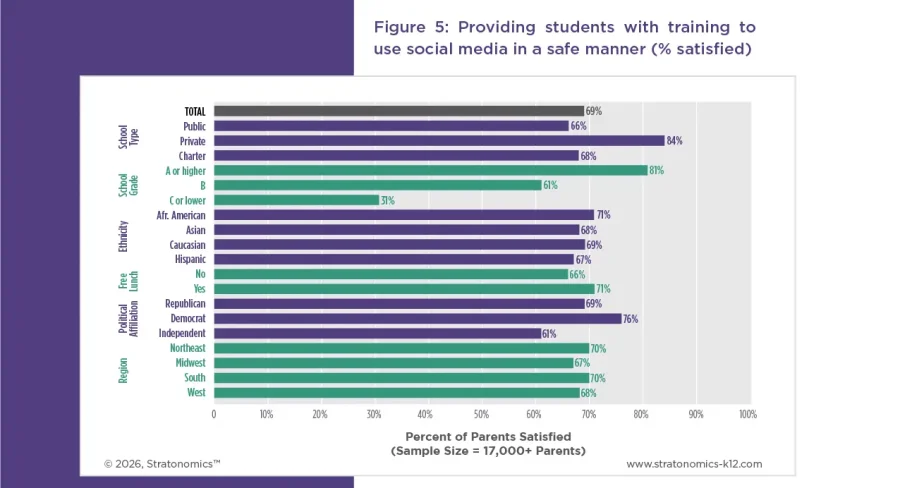
As shown in Figure 5, most parents (69%) are satisfied with the training provided to students for using social media. Furthermore:
• Satisfaction is strongest among parents of private school students and those attending schools graded A or higher.
• Democrats are most satisfied with the training provided to students for using social media.
• Satisfaction is lowest (31%) among parents of students in schools graded C or lower.
• Qualifying for free/reduced lunch has little impact on satisfaction.
• Ethnicity does not drive satisfaction with training on using social media.
• Satisfaction does not vary significantly by region.
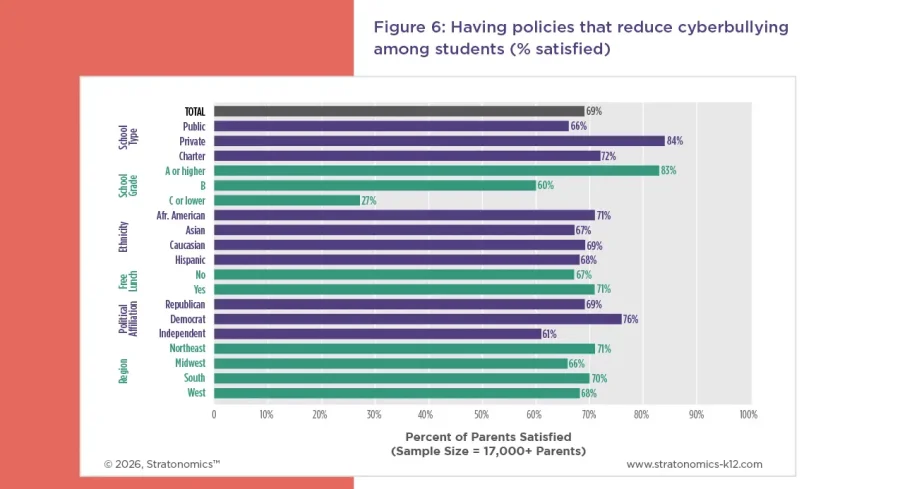
As shown in Figure 6, most parents (69%) are satisfied with their schools having policies that reduce cyberbullying among students. Furthermore:
• Satisfaction with schools having policies that reduce cyberbullying among students is strongest among parents of private school students and those who grade their school A or higher.
• Democrats are most satisfied with policies that reduce cyberbullying.
• Just 27% of parents of students in schools graded C or lower are satisfied with these policies.
• Little difference in satisfaction emerges among parents of students qualifying for free/reduced lunch compared to those who do not.
• Ethnicity is not a major factor determining satisfaction with schools having policies that reduce cyberbullying.
• Satisfaction does not vary significantly by region.
The results support several key conclusions. These include:
• Parents generally agree that technology has the potential to impact the classroom negatively. The majority agree that:
° Social media can be distracting.
° Cyberbullying is a major problem in schools.
° They would support cell phones being banned in schools.
• Overall, the social impact of technology can be quite negative, not withstanding its contributions to pedagogical development.
More specifically:
° Agreement about these negative aspects of social media, cell phones, and cyberbullying is strongest among parents of private school students and those grading their schools A or higher.
° Caucasians and Asian parents are some-
what more likely to support cell phones being banned in schools than parents of African American or Hispanic students.
° Few differences in agreement emerge
based on parents’ political affiliation, region, or whether their student receives free/reduced lunch.
• The majority of parents are satisfied with how their schools handle technology safety, specifically in terms of:
° Providing internet safety education.
° Training students to use social media safely.
° Having policies to reduce cyberbullying.
• More specifically:
° Satisfaction with these policies is strongest among parents of private school students and those grading their schools A or higher, as well as among Democrats.
° Satisfaction with technology safety is driven by how schools are graded. Parents of students in schools graded C or lower are consistently dissatisfied with the way their schools handle technology-
related issues.
° Few differences in satisfaction appear to be driven by ethnicity, region, or whether students qualify for free/reduced lunch.
Insights from this report can enable school districts’ strategic plan by ensuring that the potential downsides of students’ use of internet and social media is appropriately balanced with its upside in educating students. Technology is a strategic lever for most schools, yet its implementation requires careful assessment of the execution levers of technology. To improve value for parents and students a Science-Driven StrategyTM is the need of the hour.
Mittal, Vikas (2026) “Cyber Safety & Cyberbullying: The Parent Perspective,” Stratonomics-K12TM Strategy Science Study, 1-11.