Students and their parents rarely define a “good school” by its programs or infrastructure alone. Good schools give students relationships with teachers who listen to and care about them.
Meta-analytic evidence based on studies including 88,417 students and their parents shows that positive, affective relationships between teachers and students are associated with high levels of engagement and achievement across grade levels. Another meta-analysis of 58,368 students shows that students who perceive higher teacher support report more positive academic emotions (e.g., enjoyment and pride) and fewer negative academic emotions (e.g., anxiety and boredom) than do their peers. Students’ perceptions of having caring adults in their schools are associated with reduced absenteeism and behavioral issues and improved overall adjustment.
Research into what defines a good school allows us to measure the beliefs of the most critical stakeholder in education: parents who entrust their children to school districts. Specifically, it allows us to explore to what extent parents are satisfied or dissatisfied with teachers’ ability to forge positive, supportive, and constructive relationships with their students. And the results can be a critical input into a school district’s strategy plan.
A customer-focused strategy enables educational institutions to identify the needs providing the most value to parents, align strategy execution to the parents’ needs, and ultimately improve customer loyalty and academic outcomes. Without a clear understanding of parents’ value drivers, school district strategies inevitably miss the mark, leading to declining enrollment and academic achievement.

Since 2022, the Stratonomics-K12TM Strategy Science Study has measured parents’ beliefs and attitudes about, as well as satisfaction with, their child’s education. The ongoing study measures parent satisfaction with different dimensions of K-12 education, along with their agreement with various statements about the school experience.
The report focuses on the use and impact of the internet and technology in schools. The results are based on responses from 17,700 parents of children in grades K through 12.
Stratonomics-K12 measures parents’ beliefs and attitudes about their child’s education.
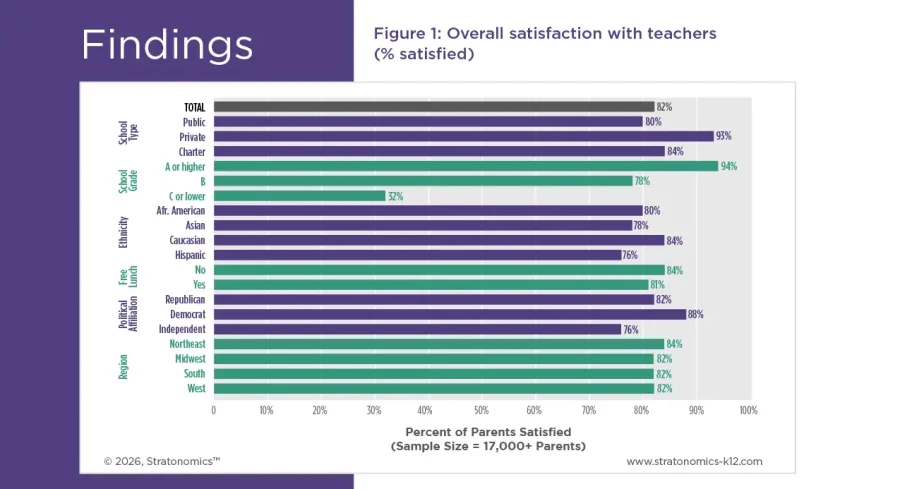
As shown in Figure 1, 82% of parents are satisfied with the teachers in their children’s schools. Furthermore:
• Satisfaction with teachers is strongest among parents of students in private schools and schools they grade A or higher. Satisfaction is lowest among parents who grade their school C or lower.
• Caucasian parents are somewhat more satisfied with their students’ teachers than are African American, Asian, and Hispanic parents.
• Democrats are more satisfied than Republicans or Independents.
• Satisfaction is similar regardless of whether the child has access to free/reduced lunch.
• Region is not a major factor influencing satisfaction.
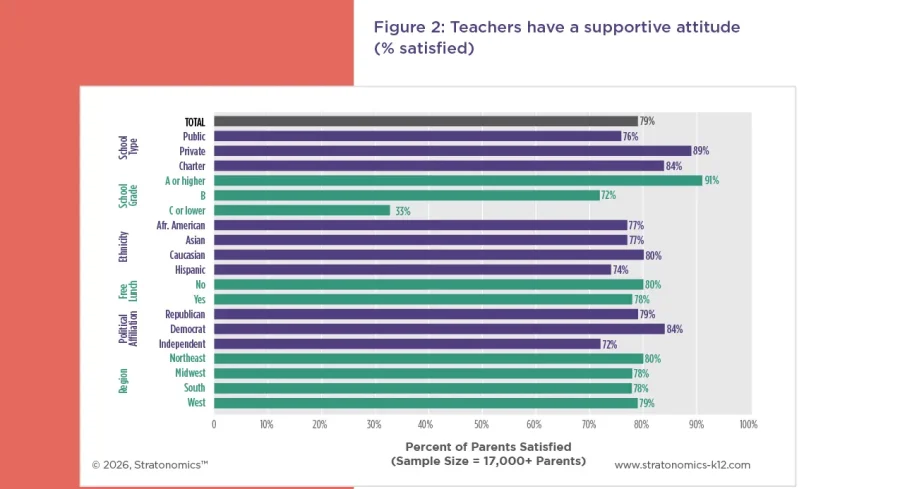
As shown in Figure 2, 79% of parents are satisfied with their children’s teachers [having] a supportive attitude. Furthermore:
• Parents of students in private schools and, to a slightly lesser extent, charter schools are more satisfied than public-school parents.
• Satisfaction that teachers have a supportive attitude is strongest among parents grading their school A or higher. Satisfaction is lowest among parents who grade their school C or lower.
• Democrats are somewhat more satisfied than Republicans and are considerably more satisfied than Independents.
• Ethnicity has little impact on satisfaction.
• Satisfaction is similar regardless of whether the child has access to free/reduced lunch.
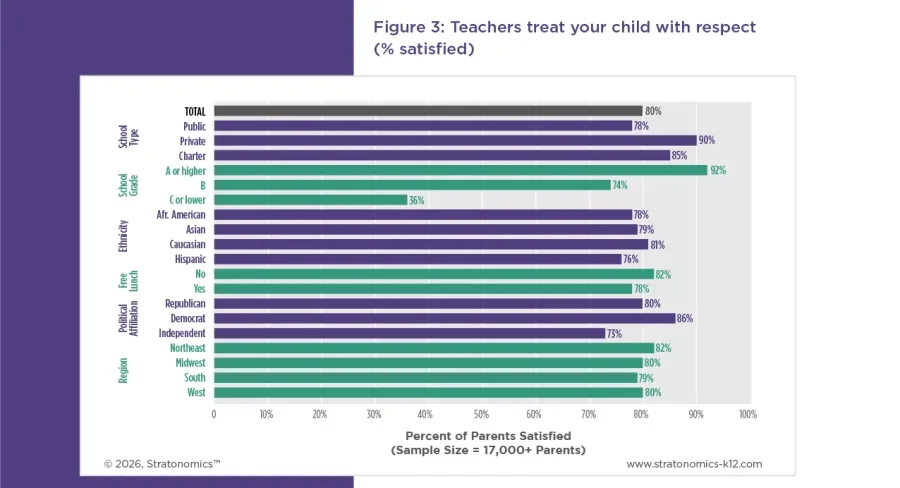
As shown in Figure 3, 80% of parents are satisfied with the extent to which teachers treat [their] child with respect. Furthermore:
• Parents of students in private schools and, to a slightly lesser extent, charter schools are more satisfied than public school parents.
• Satisfaction that teachers treat children with respect is strongest among parents grading their school A or higher. Satisfaction is lowest among parents who grade their schools C or lower.
• Democrats are somewhat more satisfied than Republicans and considerably more satisfied than Independents.
• Ethnicity has little impact on satisfaction.
• Satisfaction does not vary substantially based on students having access to free/reduced lunch.
• Region does not impact level of satisfaction.
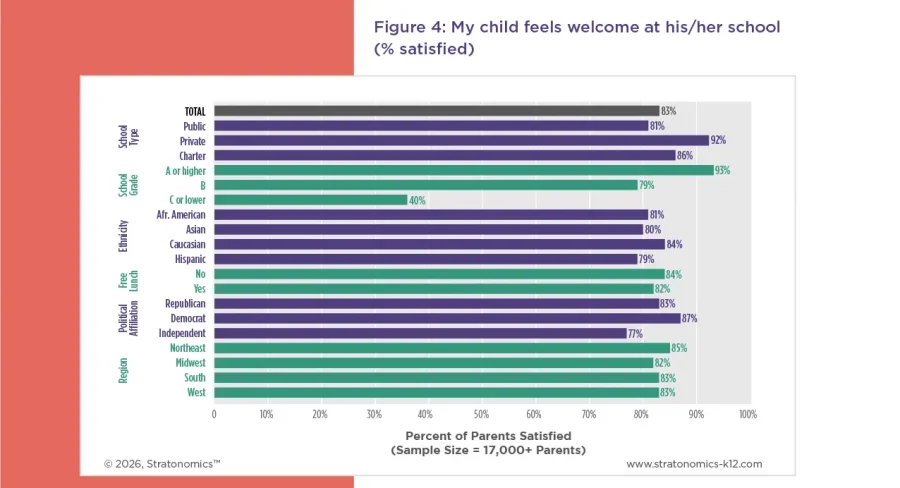
As shown in Figure 4, 84% of parents are satisfied that their child feels welcome at his/her school. Furthermore:
• Satisfaction is strongest among parents of students in private and charter schools.
• Parents grading their school A or higher are the most satisfied group, followed by parents grading their school B. Those who grade their school C or lower are least satisfied that their child feels welcome at his/her school.
• Ethnicity has little impact on satisfaction.
• Democrats and Republicans are similarly satisfied. Both groups are more satisfied than Independents.
• Access to free/reduced lunch has little impact on satisfaction.
• Satisfaction is similar across regions.
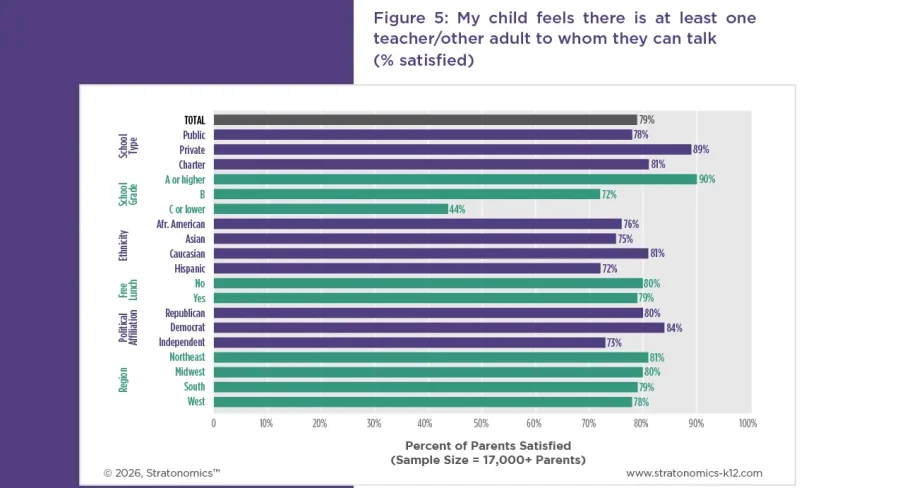
As shown in Figure 5, 79% of parents are satisfied that their child feels there is at least one teacher/other adult to whom they can talk. Furthermore:
• Satisfaction is strongest among parents of students in private schools and those grading their school A or higher. Satisfaction is lowest among parents who grade their school C or lower.
• Caucasian parents are slightly more satisfied than those identifying with other ethnicities.
• Democrats and Republicans are similarly satisfied. Both groups are more satisfied than Independents.
• Access to free/reduced lunch has little impact on satisfaction.
• Satisfaction does not vary substantially by geographic
region.
Most parents are satisfied that their children are being supported and their relational needs are being met in school.
• Parents are highly satisfied with the teachers, overall, as well as teachers having a supportive attitude and treating children with respect.
° Satisfaction is strongest among parents of private school students and those who grade their school A or higher.
° Parents of students in charter school are also more satisfied than public school parents, that their teachers have a supportive attitude and treat children with respect.
• Few differences in satisfaction emerge based on ethnicity, region or access to free/reduced lunch
• Parents are extremely satisfied that their children feel welcome in their school and have at least one adult to whom they can talk.
° Satisfaction with these dimensions is highest among parents of private-school students (followed by charter school parents) and those who grade their child’s school A or higher.
° Few differences in satisfaction emerge based on ethnicity, political affiliation, region, or access to free/reduced lunch.
Insights from this report can enable school districts’ strategic planning by leading them to encourage teachers to build strong relationships with students.
Mittal, Vikas (2026) “Beyond Teaching: Supporting Student Well Being in K12 Education,” Stratonomics-K12TM Strategy Science Study, 1-11.