

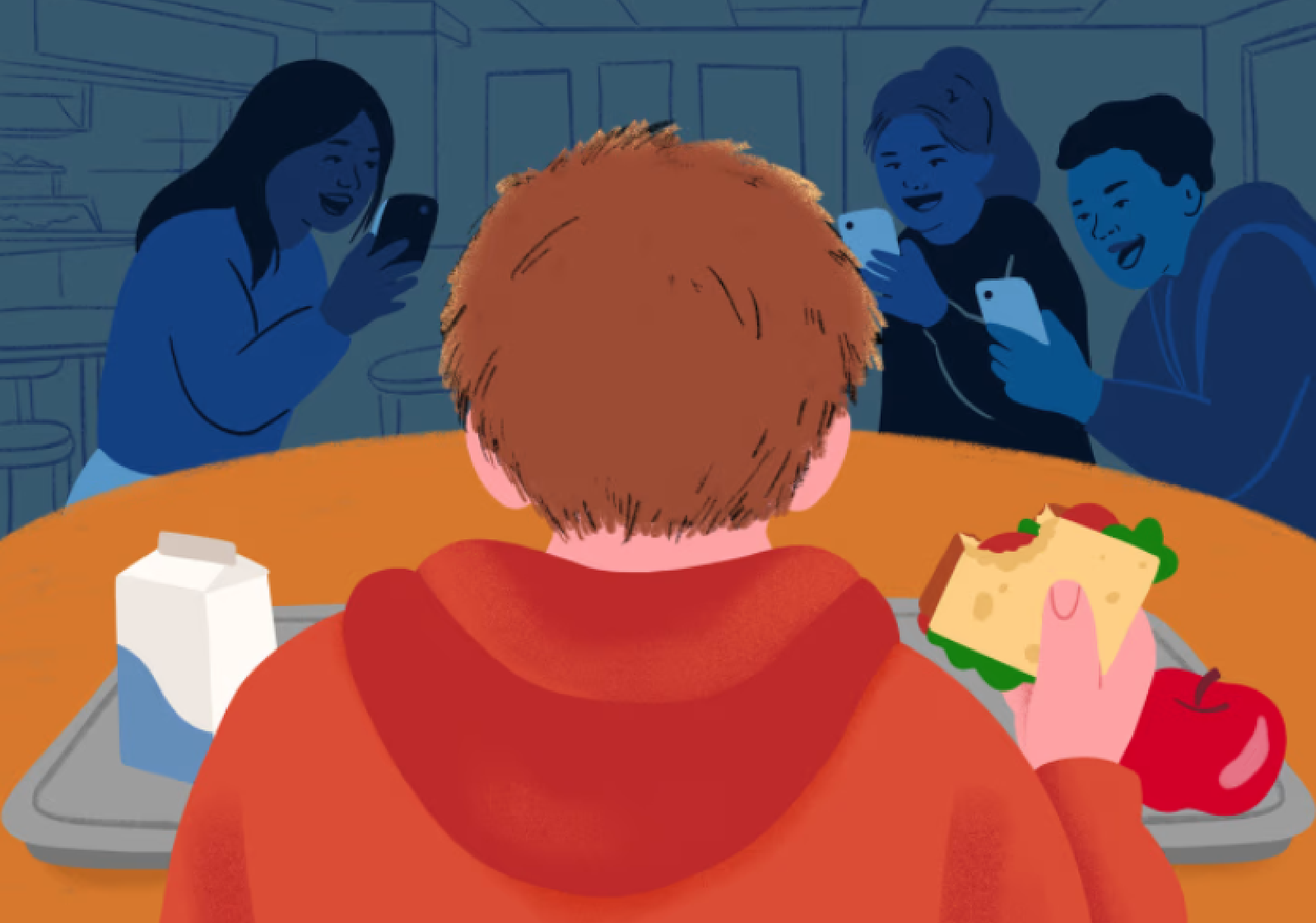
An insidious bullying tactic is creeping into school cafeterias across the country: Kids are snapping and sharing photos of other students eating lunch.
The shaming tends to fall into two categories: the ugly mouthful and the lonely eater.
Christian Okafor, a high-school senior in San Diego, says he has been the subject of unflattering lunch photos 30 to 40 times. “It makes you feel self-conscious and like you have to hide while eating,” he says.
The 18-year-old says the lunch shaming caused him to scout secluded places on his school’s outdoor campus to eat. Over time, Okafor says he learned to brush it off. He says he regularly witnesses it happening to other students but hasn’t reported the behavior to administrators because he doesn’t feel there’s much they could do about it.

“Catching people doing embarrassing things has been going on for some time, and this is the more recent iteration of that,” says Catherine Bradshaw, a professor and senior associate dean for research at the University of Virginia.
School cafeterias are a common place for bullying to occur, she says, because the student-to-staff ratio is much higher than in a classroom. Bradshaw, who studies children’s mental health and bullying prevention, has been collecting data on 25,000 students. When asked where at school they’ve been bullied in the past month, 14% of elementary students and 18% of both middle- and high-school students reported it happening in the cafeteria.
Recent graduate Nihar Patel hadn’t eaten lunch in the cafeteria at his Fairfield, Ohio, school since his freshman year because of lunch-shaming. He says he personally was never a target, though. One of his good friends was biting into a turkey sandwich when she noticed a flash: A group of other girls had taken her photo and posted it to the school’s Class of 2026 Snapchat page.
“She stopped eating at school,” 18-year-old Patel says, explaining that his friend didn’t want to talk about it but gave him permission to. “I know she’s always had body issues.”
Patel, his friend and a few others began eating lunch in a teacher’s classroom after that. Though safe from the camera bullies, Patel’s classmate didn’t eat in front of anyone again until this school year.

Recent graduate Nihar Patel hadn’t eaten lunch in the cafeteria at his Fairfield, Ohio, school since his freshman year because of lunch-shaming. He says he personally was never a target, though. One of his good friends was biting into a turkey sandwich when she noticed a flash: A group of other girls had taken her photo and posted it to the school’s Class of 2026 Snapchat page.
“She stopped eating at school,” 18-year-old Patel says, explaining that his friend didn’t want to talk about it but gave him permission to. “I know she’s always had body issues.”
Patel, his friend and a few others began eating lunch in a teacher’s classroom after that. Though safe from the camera bullies, Patel’s classmate didn’t eat in front of anyone again until this school year.
Lunch shaming has extra dimensions of cruelty beyond just making people look bad mid-bite, says Stine Kaplan Jørgensen, associate professor of social psychology at University College Copenhagen, who has been studying bullying for more than a decade. Other struggles students might be facing, such as body-image issues, food allergies or lower socioeconomic status come into play. And because photos can be snapped so quickly, it’s often hard for school supervisors to know it’s even happening.
“It’s the subtle hidden bullying that’s the worst,” Kaplan Jørgensen says.
School districts have been implementing phone bans because of classroom distraction as well as students using them to film fights, spread gossip and bully one another.
Early research shows school phone bans have cut down on student disciplinary problems and boosted test scores. Some districts restrict phones all day while others allow students to have them during passing periods and lunch. After the Aberdeen School District in Washington implemented a full-day phone ban a few years ago, officials noticed a sizable increase in the number of middle-school students taking school-provided lunches.
“They were getting their lunch because they no longer feared having their photos taken,” says Traci Sandstrom, one of the district’s co-superintendents.
Patel says a schoolwide phone ban that went into effect this past fall has curbed a lot of the lunch-shaming photos. Where did the bullies turn their attention? He says some kids now post to an Instagram page dedicated to photos of bad student drivers.