

School administrators and school boards play a crucial role in a school district’s success. School boards set the district’s direction; they hire and evaluate the superintendent, establish goals, approve budgets, and hold the superintendent accountable. Indeed, research shows that strong, stable school boards can positively influence student test scores.
Working with their board, school-district superintendents set strategy and implement it through school principals, staff, and other district leaders. Research shows that district leaders shape principal effectiveness, instructional coherence, and organizational culture—all combining to impact student outcomes.
Together, boards and superintendents can form a partnership where the boards concentrate on providing a strategic vision and accountability and superintendents concentrate on developing a strategy and implementing it. Implementation might include strategic areas like instructional quality, teacher recruitment and retention, parent interaction, and aligning different operational areas for success. When boards and superintendents work well together, teachers teach effectively, students thrive, and parents are satisfied.
To set and implement an effective strategy, however, school districts must account for the views of their most critical stakeholders: parents who entrust their children to them. A customer-focused strategy enables educational institutions to identify the customer needs providing the most value to parents, align strategy execution to those needs, and ultimately improve customer loyalty and academic outcomes. Without a clear understanding of parents’ value drivers, school district strategies miss the mark, leading to declining enrollment and academic achievement.
Since 2022, the Stratonomics-K12TM Strategy Science Study has measured parents’ beliefs and attitudes about, as well as satisfaction with, their child’s education. The ongoing study measures parent satisfaction with different dimensions of K-12 education, along with their agreement with various statements about the school experience.
The report focuses on the use and impact of the internet and technology in schools. The results are based on responses from 17,700 parents of children in grades K through 12.
Stratonomics-K12 measures parents’ beliefs and attitudes about their child’s education.


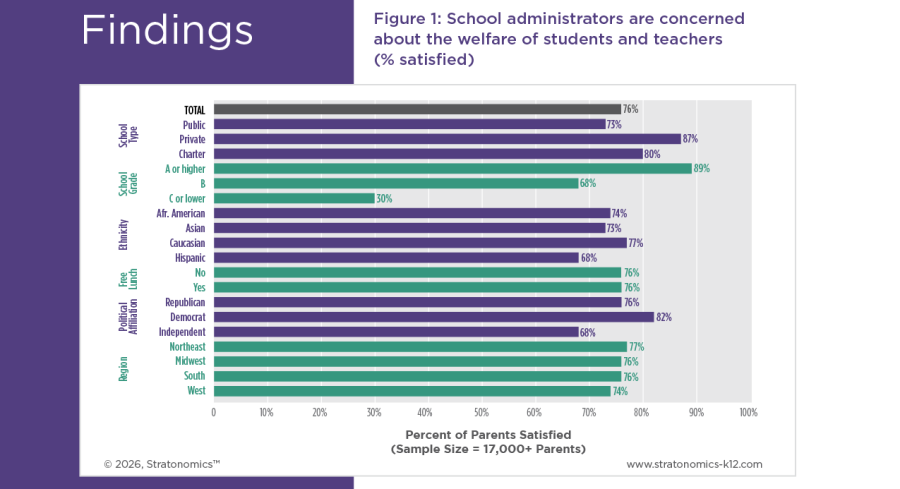
As shown in Figure 1, most parents (76%) are satisfied that their school administrators are concerned about the welfare of students and teachers. Furthermore:
• Satisfaction is strongest among parents of students in private schools and schools graded A or higher. Satisfaction is weak among parents grading their student’s school C or lower.
• Hispanic parents are consistently less satisfied than those of other ethnicities.
• Democratic parents are somewhat more consistently satisfied than Republican parents and considerably more consistently satisfied than Independents.
• Access to free/reduced lunch has no impact on satisfaction.
• Region is not a major factor influencing satisfaction.
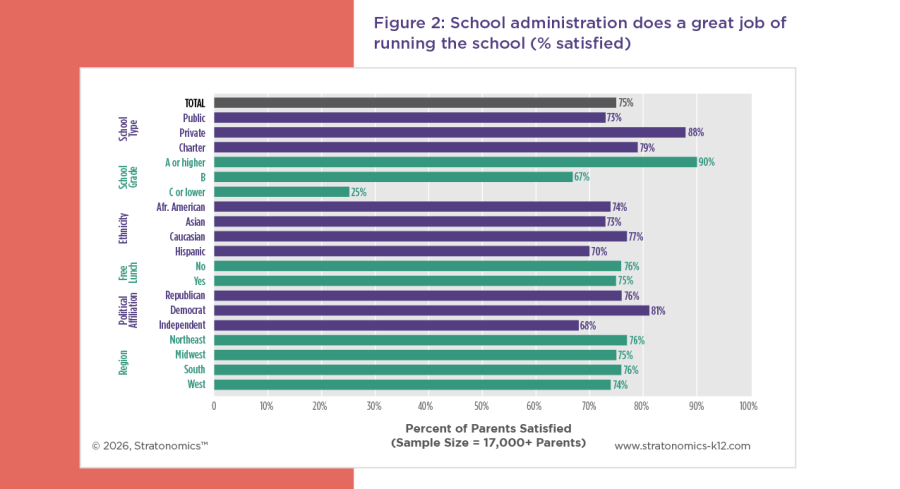
As shown in Figure 2, most parents (75%) are satisfied that school administration does a great job of running the school. Furthermore:
• Parents of private school students are most satisfied, followed by parents of charter school students. Somewhat fewer public-school parents are satisfied.
• Parents grading their student’s school A or higher are most satisfied; those grading their student’s school C or lower are least satisfied.
• Democrats are slightly more satisfied than Republicans and both are considerably more satisfied than Independents.
• Ethnicity has little impact on satisfaction.
• Satisfaction does not vary significantly based on whether a child has access to free/reduced lunch.
• Region has little impact on satisfaction.
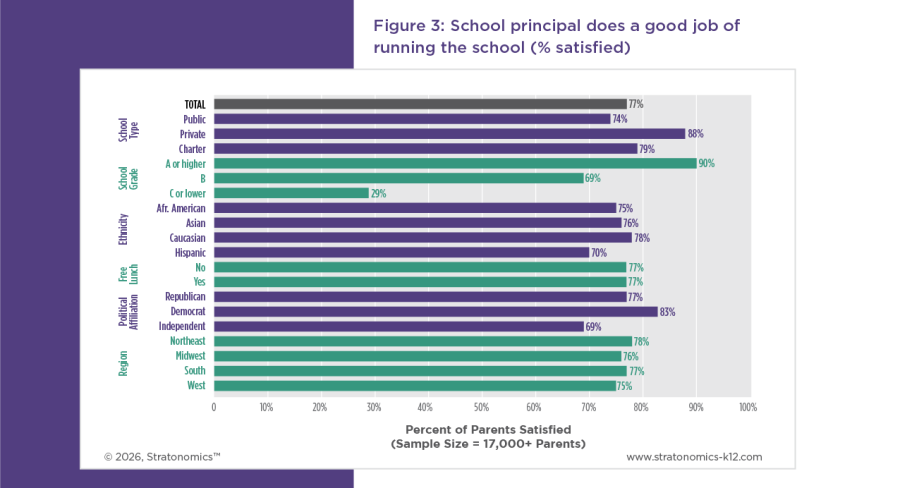
As shown in Figure 3, most parents (77%) are satisfied that the school principal does a good job of running the school. Furthermore:
• Satisfaction is strongest among parents of students in private schools, and schools the parents grade A or higher. Satisfaction is lowest among parents who grade their student’s school C or lower.
• Hispanic parents are somewhat less satisfied than those of other ethnicities.
• Democrats are more satisfied than Republicans or Independents.
• Satisfaction that the school principal does a good job running the school is similar regardless of whether the child has access to free/reduced lunch.
• Region has little impact on satisfaction.
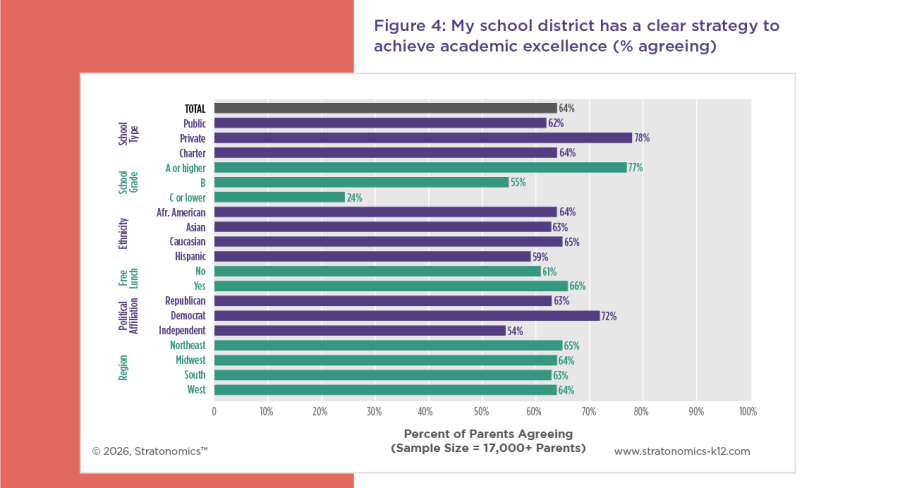
As shown in Figure 4, more than half of parents (64%) agree that my school district has a clear strategy to achieve academic excellence. Furthermore:
• Agreement is stronger among parents of private school students than parents of charter or public-school students.
• Parents grading their school A or higher most strongly agree.
• Hispanics are slightly less likely to agree than other ethnicities.
• Access to free/reduced lunch impacts agreement; parents of students with access more strongly agree than those of students without access.
• Democrats agree somewhat more than Republicans and considerably more than Independents.
• Agreement does not vary significantly by region.
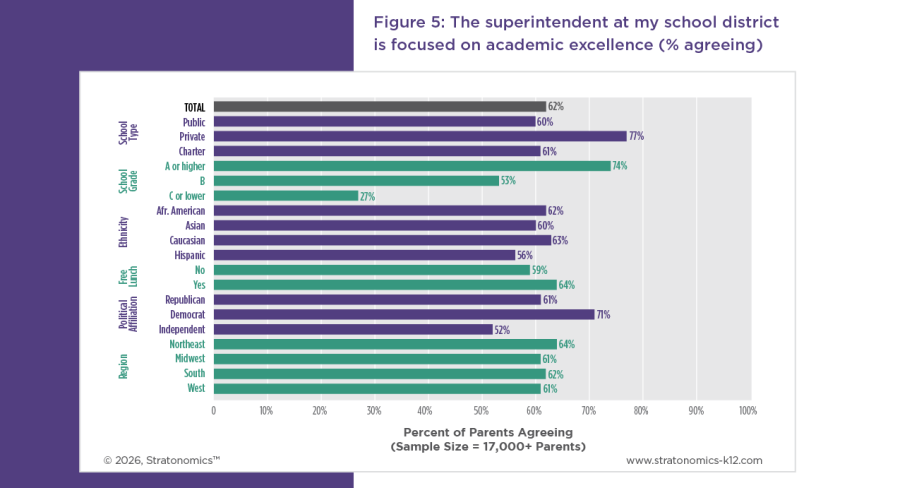
As shown in Figure 5, more than half of parents (62%) agree that the superintendent at my school district is focused on academic excellence. Furthermore:
• Agreement is stronger among parents of private school students than parents of charter or public-school students.
• Parents grading their school A or higher most consistently agree.
• Hispanics are slightly less likely to agree than other ethnicities.
• Access to free/reduced lunch impacts agreement; parents of students with access more strongly agree than those of students without access.
• Democrats agree more consistently than both Republicans and Independents.
• Region has little impact on agreement.
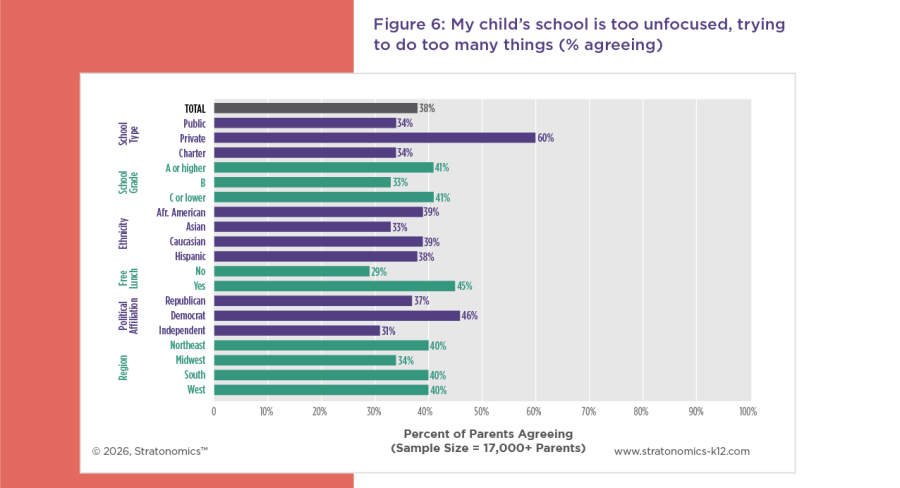
As shown in Figure 6, few parents (38%) agree that my child’s school is too unfocused, trying to do too many things. Furthermore:
• More parents of private school students agree than parents of charter or public schools.
• Parents grading their school B are less likely to agree than those grading their school higher or lower than B.
• Though agreement is low among all ethnicities, it is lowest among Asian parents.
• Parents of students with access to free/reduced lunch agree more consistently than do those whose students do not have access.
• Democrats agree more consistently than Republicans or Independents.
• Parents in the Midwest are less likely to agree than parents in other regions.
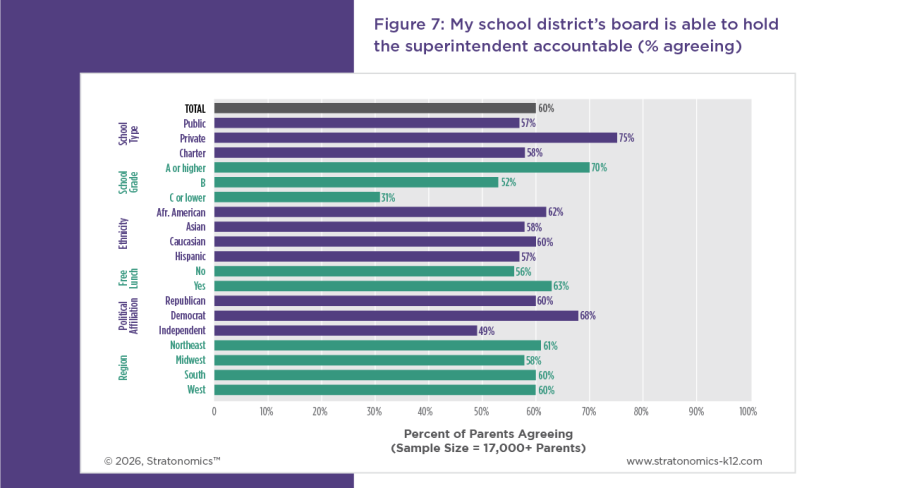
As shown in Figure 7, more than half of parents (60%) agree their school district’s board is able to hold the superintendent accountable. Furthermore:
• Parents of private school students and those grading their student’s school A or higher most consistently agree.
• Parents of students with access to free/reduced lunch agree more strongly than do those whose students do not have access.
• Democrats agree more consistently than Republicans or Independents.
• There is little difference in agreement based on ethnicity.
• Region has little impact on agreement.
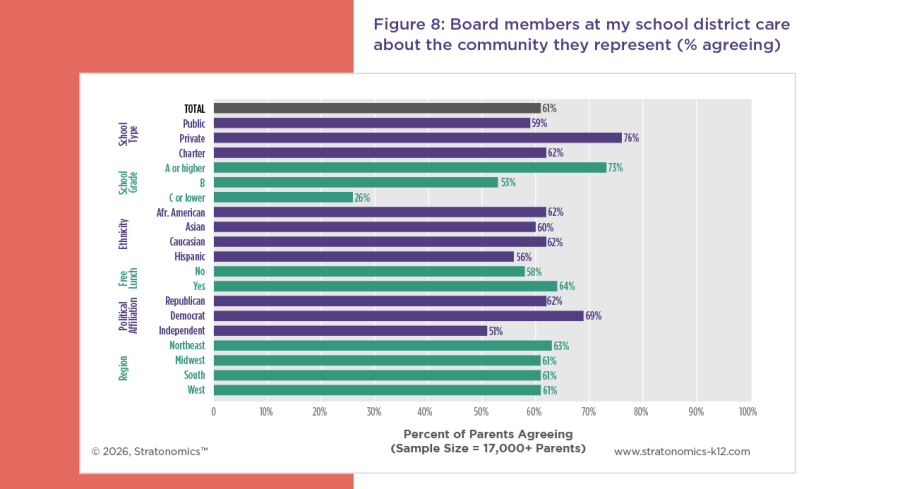
As shown in Figure 8, more than half of parents (61%) agree that board members at [their] school district care about the community they represent. Furthermore:
• Agreement is stronger among parents of private-school students than parents of charter or public-school students.
• Parents who grade their school A or higher agree most. Agreement is weak among those grading their school C or lower.
• Agreement is somewhat lower among Hispanics than other ethnicities.
• Access to free/reduced lunch impacts agreement; parents whose students have access more consistently agree than those whose students do not have access.
• Democrats agree more consistently than both Republicans and Independents.
• Region has no impact on agreement.
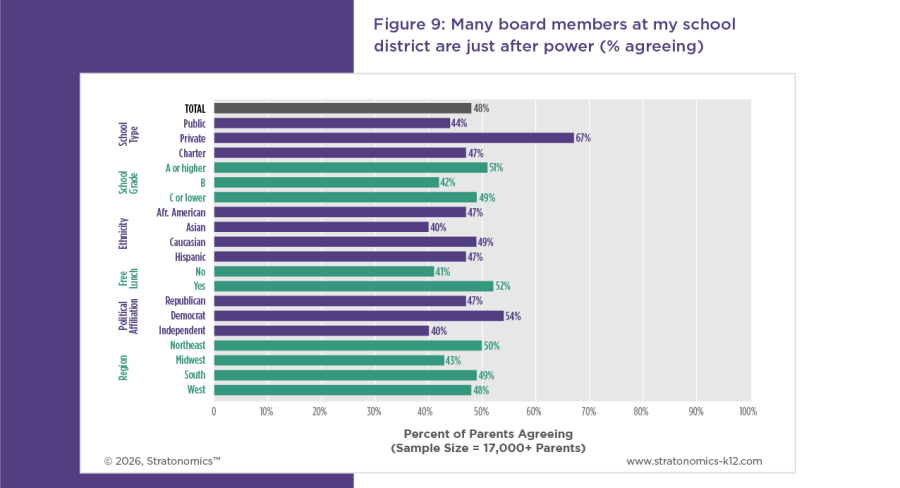
As shown in Figure 9, just short of half of parents (48%) agree that many board members at [their] school district are just after power. Furthermore:
• More parents of private school students agree than parents of charter or public-school students.
• Parents grading their school B are less likely to agree than those grading their school higher or lower than B.
• Though agreement is low among all ethnicities, it is lowest among Asians.
• Parents of students with access to free/reduced lunch agree more strongly than those whose students do not have access.
• Democrats agree more consistently than Republicans or Independents.
• Parents in the Midwest are less likely to agree than parents in other regions.
Parents are satisfied with their school districts’ leadership for the most part. They are highly satisfied that their school administrators are caring and do a good job running their schools. They are somewhat less satisfied that administrators have a focused strategy regarding academics. School boards are considered moderately effective, but half of parents agree that board members may just be after power. Furthermore:
• Parents are consistently satisfied that their school administrators are concerned about the welfare of students/teachers (76%). Parents are satisfied that school administrators (75%) and principals (77%) do a good job of running their schools.
° Satisfaction is strongest among parents in private schools, those who grade their student’s school A or higher, and Democrats.
• More than half agree that their school district has a clear strategy to achieve academic excellence (64%) and the superintendent is focused on academic excellence (62%). However, 38% agree that the school is too unfocused, trying to do too many things.
° Agreement with the three statements about administration strategy is strongest among parents of students in private schools, Democrats, and parents of students with access to free/reduced lunch.
• More than half of parents agree their school districts’ board is able to hold the superintendent accountable (60%) and board members care about the community they represent (61%). However, almost half (48%) agree that many board members are just after power.
° Agreement with the three statements about school board efficacy is strongest among parents of students in private schools, Democrats, and parents whose students have access to free/reduced lunch.
Insights from this report can inform school districts regarding parents’ satisfaction with the leadership at their schools.
Mittal, Vikas (2026), “Effectiveness of School Administrators and School Boards: A Parents Perspective,” Stratonomics-K12™ Strategy Science Study, 1-15.