© 2026 by StratonomicsTM. This document is licensed to be used only by permission from Stratonomics-K12TM. All information shared is copyrighted, proprietary, and confidential. Do not copy, record, share, store, distribute, use in language or learning models, modify content, use for teaching purposes without full attribution, assign as reading, transmit, or otherwise use in any capacity (e.g., corporate presentations or strategy planning) without express written permission and full attribution. Contact info@stratonomics.inc for rights and permissions.

www.stratonomics-k12.com

Stratonomics-K12TM Strategy Science Study

industry insights assets k12-02

Stratonomics-K12TM Strategy Science Study

Background

”Public schools are approaching a ‘make or break’ moment.”

Miguel Cardona, Secretary of State

“Public K-12 schools lost more than 1.2 million students in the first two years after the COVID-19 pandemic.” According to an NBC News report, public school enrollment declined by 4 percentage points from 2012 to 2022, with enrollments declining more than 7 percentage points in states like South Carolina and Alaska.

The Secretary of Education at the time, Miguel Cardona, took notice. “Public schools are approaching a ‘make or break’ moment,” Cardona said in September 2023.

District administrators and school leaders increasingly rely on online strategies to boost enrollment and student engagement. However, many of the strategies are based on views expressed by teachers and school insiders. In a 2023 EdWeek survey, 76% of students said technology makes learning more engaging. In the 2023 State of Technology in Education report, 90% of teachers said technology helps them assess student learning more effectively.

While important, these studies do not account for the views of the most critical stakeholder in schools: parents who entrust their children to school districts. A customer-focused strategy enables educational institutions to identify the customer needs providing the most value to parents, align strategy execution to those needs, and ultimately improve customer loyalty and academic outcomes. Without a clear understanding of parents’ value drivers, school district strategies miss the mark, leading to declining enrollment and academic achievement.

www.stratonomics-k12.com

1

Stratonomics-K12TM Strategy Science Study

Research Methodology

Since 2022, the Stratonomics-K12TM Strategy Science Study has measured parents’ beliefs and attitudes about, as well as satisfaction with, their child’s education. The ongoing study measures parent satisfaction with different dimensions of K-12 education, along with their agreement with various statements about the school experience.

The report focuses on the use and impact of the internet and technology in schools. The results are based on responses from 17,700 parents of children in grades K through 12.

Stratonomics-K12 measures parents’ beliefs and attitudes about their child’s education.

www.stratonomics-k12.com

2

Stratonomics-K12TM Strategy Science Study

industry insights assets k12-04

www.stratonomics-k12.com

3

Stratonomics-K12TM Strategy Science Study

industry insights assets k12-05

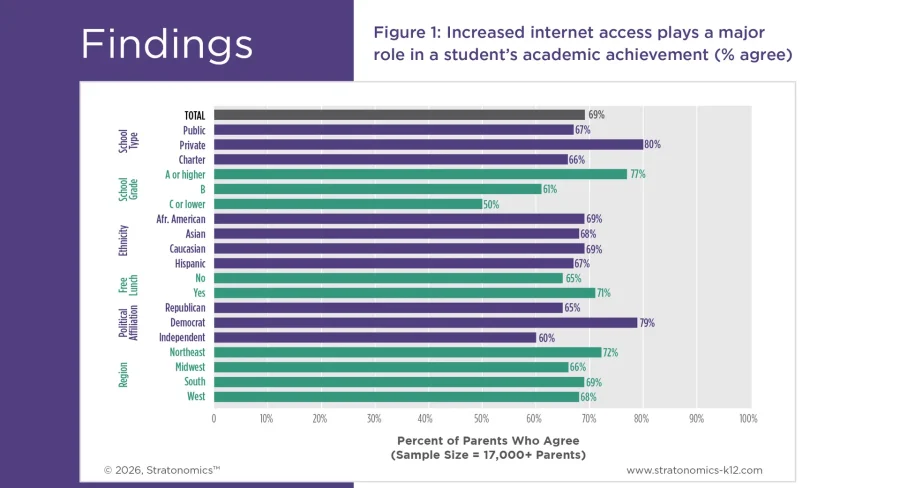
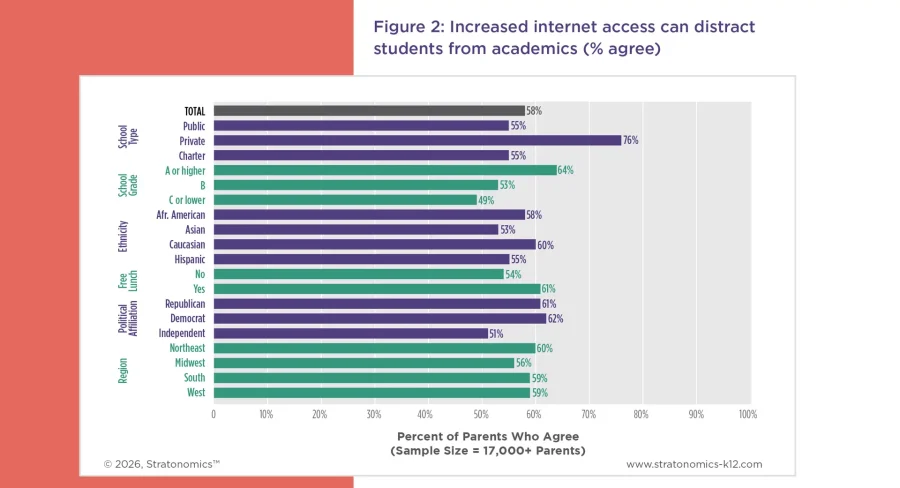
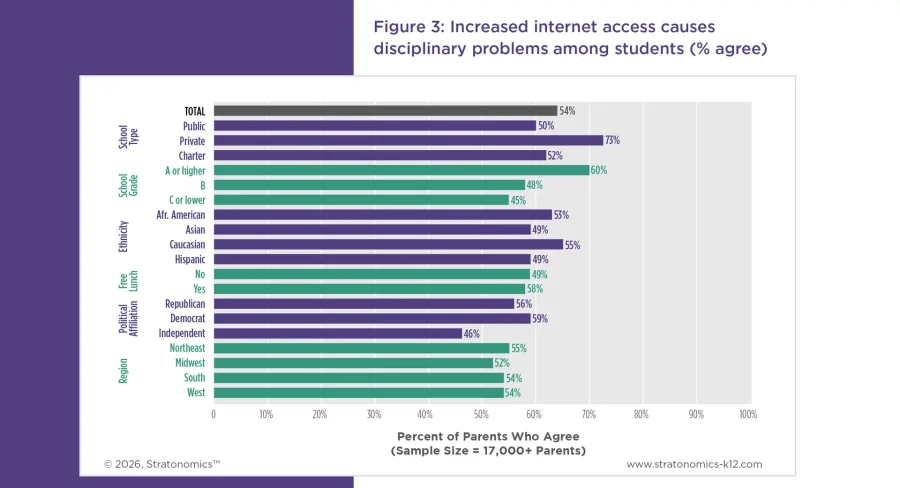
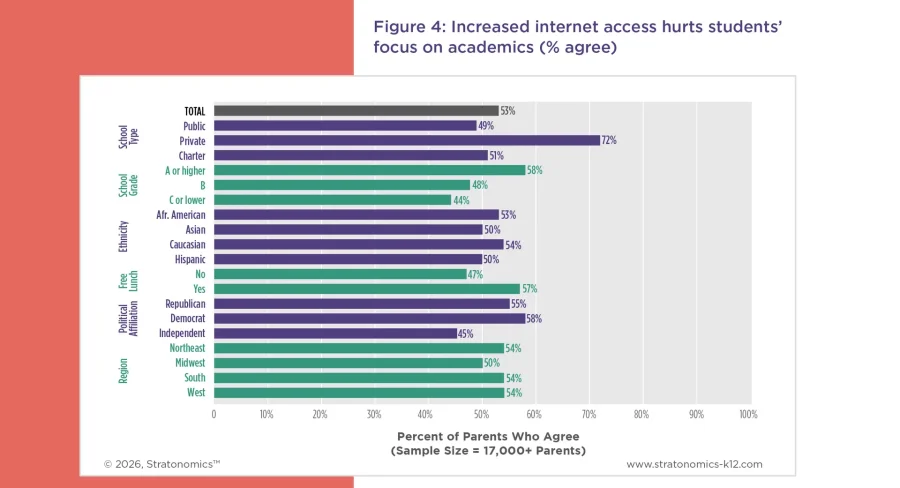
Figures 1, 2, 3, and 4 show parents’ agreement with different statements regarding internet access in schools.

As shown in Figure 1, a majority (69%) agree that increased internet access plays a major role in a student’s academic achievement. Furthermore:

• Agreement is strongest among parents of students in private schools and schools they grade A or higher.

• Democrats are more inclined to agree than Republicans or Independents.

• The level of agreement does not vary substantially by ethnicity.

• Agreement is similar regardless of whether or not the child receives free/reduced lunch.

• Region is not a major factor influencing agreement that internet access plays a major role in students’ academic achievement.

• Ethnicity does not have a major impact on agreement.

www.stratonomics-k12.com

4

Stratonomics-K12TM Strategy Science Study

industry insights assets k12-06

As shown in Figure 2, more than half (58%) agree that increased internet access can distract students from academics. Furthermore:

• Parents of students in private schools and in schools they grade A or higher are more apt to agree with the above statement.

• Agreement does not vary a great deal among parents based on whether their student receives free/reduced lunch.

• African Americans and Caucasians are somewhat more likely to agree that increased internet access can distract students, than their Hispanic and Asian counterparts.

• Democrats and Republicans agree at similar rates.

• Region is not a major factor affecting the level of agreement.

www.stratonomics-k12.com

5

Stratonomics-K12TM Strategy Science Study

industry insights assets k12-07

As shown in Figure 3, more than half (54%) agree that increased internet access causes disciplinary problems among students. Furthermore:

• Agreement is strongest among parents of students in private schools and those grading their school A or higher.

• Parents of children receiving free/reduced lunch agree at the highest rate that increased internet access causes disciplinary problems among students.

• African Americans and Caucasians are somewhat more likely to agree than their Hispanic and Asian counterparts.

• Democrats and Republicans have similar agreement that increased internet access causes disciplinary problems.

• Level of agreement does not vary by region.

www.stratonomics-k12.com

6

Stratonomics-K12TM Strategy Science Study

industry insights assets k12-08

As shown in Figure 4, just more than half of parents agree that increased internet access hurts students’ focus on academics. Furthermore:

• Agreement is strongest among parents of private school students and parents grading their school A or higher.

• Qualifying for free/reduced lunch impacts agreement such that agreement is higher among those qualifying.

• Level of agreement does not vary between Democrats and Republicans.

• Region has little impact on agreement.

• Ethnicity has little impact on agreement.

www.stratonomics-k12.com

7

Stratonomics-K12TM Strategy Science Study

industry insights assets k12-09

Figures 1, 2, 3, and 4 show parents’ agreement with different statements regarding internet access in schools.

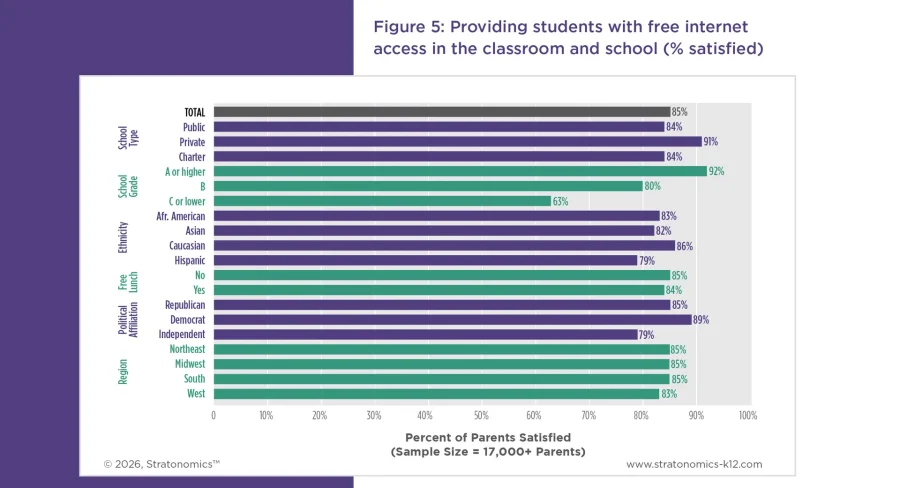
As shown in Figure 5, parents are highly satisfied (85%) with the way their schools are providing students with free internet access in the classroom and school. Furthermore:

• Satisfaction is strongest among parents of students in private schools and those grading their school A or higher.

• Parents of students qualifying for free/reduced lunch are similarly satisfied as those whose students do not.

• Ethnicity does not impact parents’ satisfaction.

• Political affiliation has little impact on parents’ satisfaction with schools providing free internet access in the classroom and school.

• Satisfaction does not vary by geographic region.

www.stratonomics-k12.com

8

Stratonomics-K12TM Strategy Science Study

industry insights assets k12-10

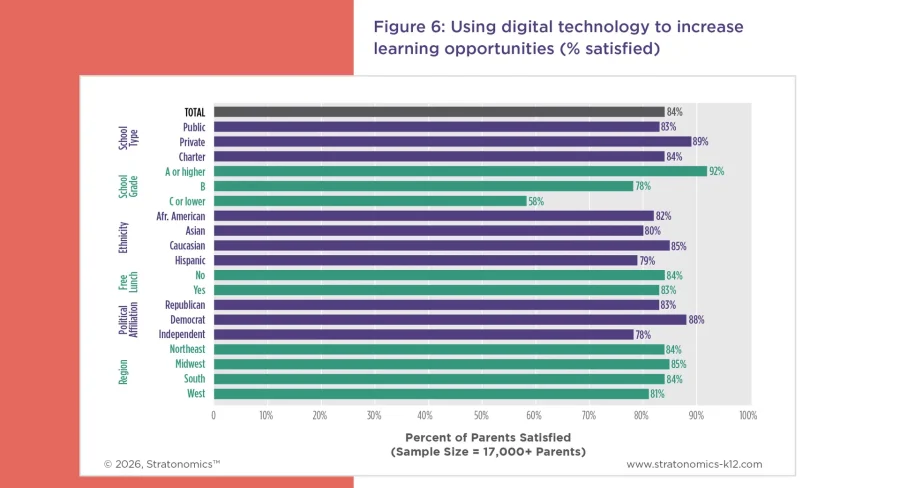
As shown in Figure 6, parents are quite satisfied (84%) with the way their schools are using digital technology to increase learning opportunities. Furthermore:

• Parents of private school students and those grading their schools A or higher are most satisfied.

• Few differences emerge based on access to free/reduced lunch.

• Democrats are most satisfied with schools’ way of using digital technology to increase learning opportunities.

• Caucasians are more satisfied than other ethnicities with schools’ use of digital technology to increase learning opportunities.

• Region has little impact on satisfaction.

www.stratonomics-k12.com

9

Stratonomics-K12TM Strategy Science Study

industry insights assets k12-11

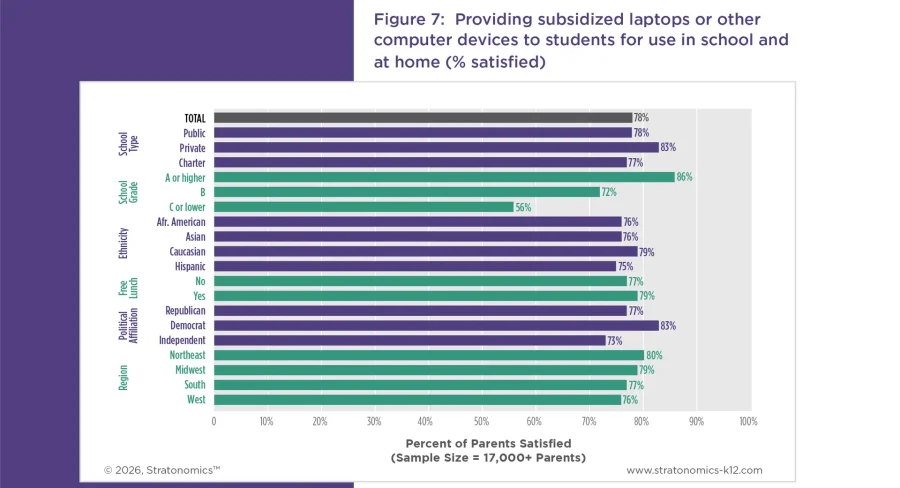
As shown in Figure 7, parents are highly satisfied (78%) with schools providing subsidized laptops/devices to students for use in school/at home. Furthermore:

• Parents of private school students and those who grade their schools A or higher are most satisfied with schools providing subsidized laptops/devices.

• Democrats express the highest satisfaction with schools providing subsidized laptops/devices to students.

• Receiving free/reduced lunch has little impact on satisfaction.

• Few differences emerge based on ethnicity.

• Satisfaction is similar across regions.

www.stratonomics-k12.com

10

Stratonomics-K12TM Strategy Science Study

industry insights assets k12-12

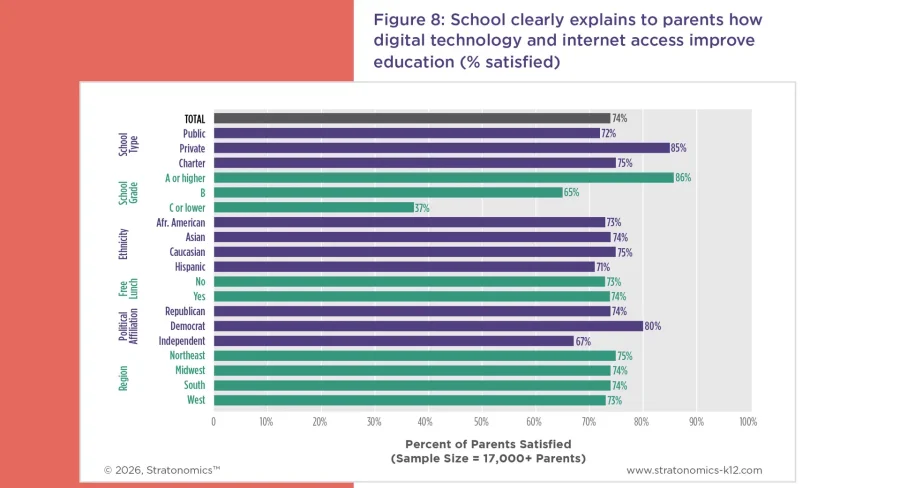
As shown in Figure 8, parents are quite satisfied (74%) that their schools clearly explain how digital technology and internet access improve education. Furthermore:

• Satisfaction is strongest among parents of private school students and those that grade their school A or higher.

• Democrats tend to be most satisfied.

• Access to free/reduced lunch has little impact on satisfaction with this issue.

• Few differences emerge based on ethnicity.

• Region has no impact on satisfaction.

www.stratonomics-k12.com

11

Stratonomics-K12TM Strategy Science Study

Key Takeaways

Key takeaways include:

• Parents are concerned and conflicted about the impact of technology on their childrens’ education.

• A majority agree that increased internet access plays a major role in students’ academic achievement. Yet, they are skeptical about its role in education.

• Specifically, many agree that internet access can be distracting to students, cause disciplinary issues, and negatively impact students’ academic focus. More specifically

° Agreement is strongest among parents of private school students (or those who grade their school A or higher) and parents of students receiving free/reduced lunch.

° Caucasian and African American parents are somewhat more likely to agree that internet access can be distracting and cause disciplinary problems than are other ethnic groups.

° Few differences emerge based on political affiliation or region.

• Satisfaction with the way schools handle technology as it relates to student education is extremely strong in terms of providing free internet access, subsidized laptops/devices, technology increasing learning opportunities, and schools clearly explaining to parents
how technology and internet access improve education. More specifically:

° For the most part, satisfaction is strongest among parents of private school students and those who grade their school A or higher.

° Democrats are more satisfied with the way their schools handle technology than are those of other political affiliations.

° Few differences in satisfaction emerge based on ethnicity, region, or access to free/reduced lunch.

Insights from this report can enable school districts’ strategic plan by ensuring that technology is appropriately placed as a strategic lever. Simply providing more technology or launching technology-based programs is unlikely to improve value for a school’s primary customer—parents and guardians of students enrolled in the school.

www.stratonomics-k12.com

12

Citation

Mittal, Vikas (2026) “Internet Usage and Student Outcomes in K12 Education,” Stratonomics-K12TM Strategy Science Study, 1-13.