

Most leaders of kindergarten to 12th grade (K12) schools believe their organization’s strategy should be to prepare students not only for college, but also for gainful employment directly after high school. What few K12 leaders know, however, is how successful they are at achieving those goals in the eyes of their most critical stakeholders: their students’ parents.
A 2026 BLS report shows that 62.8% of high school graduates ages 16 to 24 were enrolled in college in October 2024, with women (69.5%) enrolled at higher rates than men (55.4%). Among 20- to 29-year-olds, 78.1% of recent associate degree recipients, 69.6% of recent bachelor’s degree recipients, and 74.7% of recent advanced degree recipients were employed. Clearly, obtaining a college degree after high school boosts one’s chances of being employed.
The BLS study also reports that 606,000 young people dropped out of high school between October 2023 and October 2024. Among the dropouts, the labor force participation rate (based on the number of individuals with a job and looking for a job) was far lower for recent dropouts (40%) than for those who had graduated from high school (66.4%).
The BLS statistics suggest three strategic imperatives for K12 leaders.
• First, they must ensure their students graduate from high school.
• Second, they must ensure high school graduates entering the workforce immediately are ready for meaningful jobs.
• And third, they must increase their students’ college enrollment rate.
To drive their desired student outcomes, K12 leaders typically focus on a “college-and-career readiness” agenda as part of their overall strategy. While this legacy approach can be a useful place to start, it can be strengthened by incorporating the views of the parents who entrust their children to school districts.
A customer-focused strategy enables educational institutions to identify the customer needs providing the most value to parents, align strategy execution to those needs, and improve customer loyalty and academic outcomes. Without a clear understanding of parents’ value drivers, school district strategies inevitably miss the mark, leading to declining enrollment and academic achievement.
The Stratonomics-K12TM Strategy Science Study has measured parents’ beliefs and attitudes about, and satisfaction with their children’s education. The ongoing study measures parent satisfaction with different dimensions of K12 education, along with their agreement with various statements about the school experience.
The report focuses on the extent to which parents perceive their K12 students are prepared for the future, either by being college bound or ready to seek a meaningful job opportunity. The results are based on responses from 17,700 parents of children in grades K through 12.
Stratonomics-K12 measures parents’ beliefs and attitudes about, and satisfaction with their child’s education.


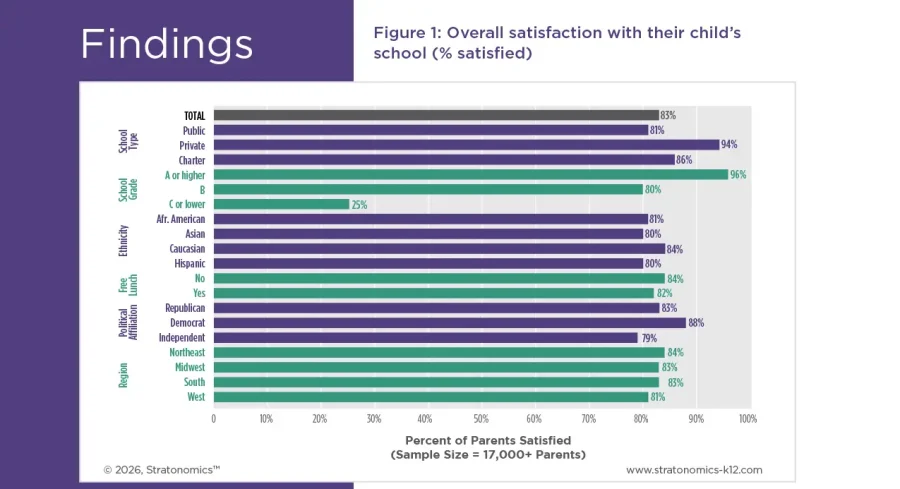
As shown in Figure 1, most parents (83%) are satisfied with their child’s school. Furthermore:
• Satisfaction is strongest among parents of students in private schools and schools the parents grade A or higher. Satisfaction is extremely low among parents that grade their school C or lower.
• Democratic parents are slightly more satisfied with their child’s school than Republican parents.
• Ethnicity does not have a major impact on satisfaction.
• Overall satisfaction with the child’s school is similar regardless of whether the child has access to free/reduced lunch.
• Region is not a major factor influencing satisfaction.
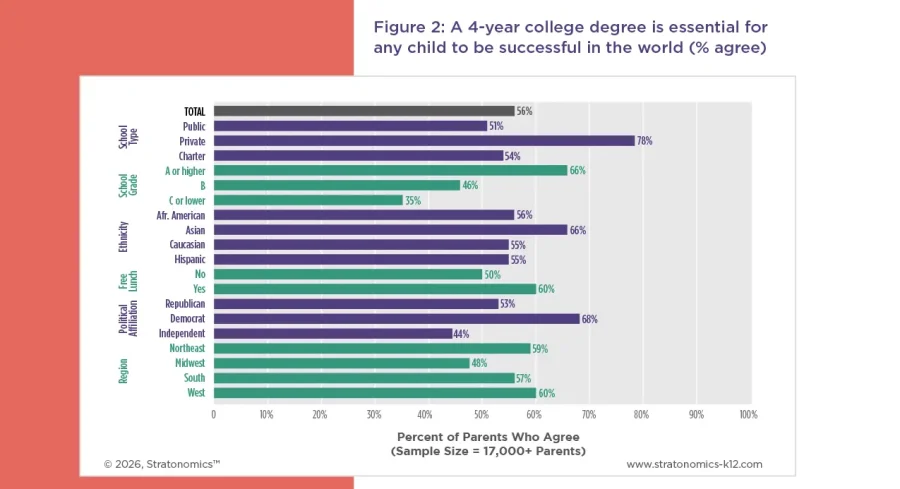
As shown in Figure 2, just over half (54%) agree that a 4-year college degree is essential for any child to be successful in the world. Furthermore:
• Agreement is strongest among parents of students in private schools and those grading their school A or higher. Parents grading their school C or lower are much less likely to agree that a college degree is essential.
• Asian parents consider a 4-year college degree more important than do all other ethnicities.
• Parents who have access to free/reduced lunch for their student agree more strongly that a college degree is essential than those who do not.
• Democrats agree more strongly than Republicans that a 4-year college degree is essential for success.
• Ethnicity has little impact on agreement.
• Parents in the Midwest agree less that a 4-year college degree is essential than do parents in other regions.
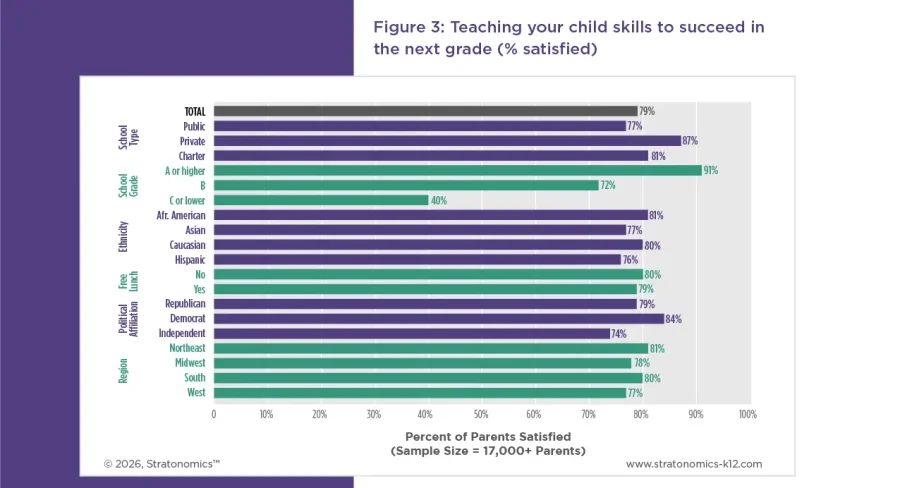
As shown in Figure 3, most parents (79%) are satisfied that their school is teaching [their] child skills to succeed in the next grade. Furthermore:
• Satisfaction is strongest among parents of students in private schools and lowest among those relying on public schools.
• Satisfaction is highest among parents grading their school A or above. Parents grading their school C or lower are least satisfied.
• Democrats are slightly more satisfied than Republicans on the dimension.
• Ethnicity has little impact on satisfaction.
• Access to free/reduced lunch has little impact on satisfaction.
• Level of satisfaction does not vary considerably by region.
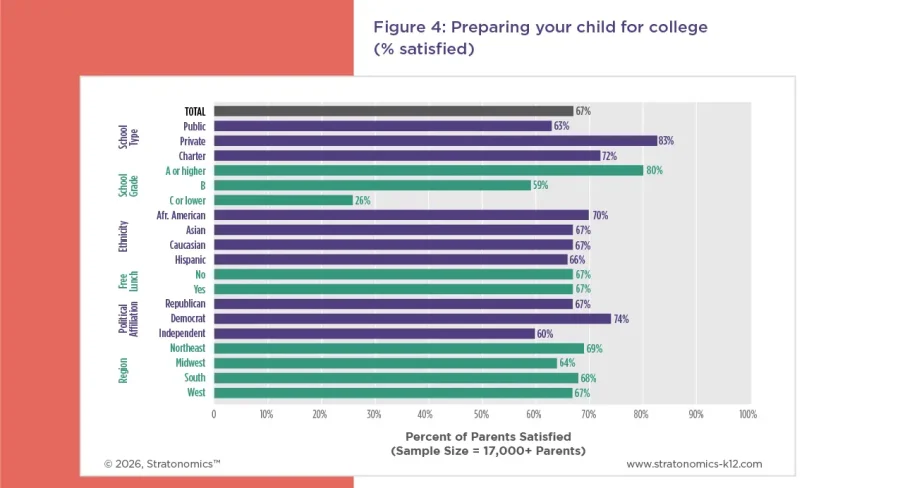
As shown in Figure 4, most parents (67%) are satisfied that their school is preparing [their] child for college. Furthermore:
• Satisfaction is strongest among parents of students in private schools, followed by charter schools. Parents of public school students are least satisfied that the school is preparing their child for college.
• Parents grading their child’s school A or higher are most satisfied that the school is preparing their child for college, followed by parents grading their school B. Schools graded C or lower generate the lowest
satisfaction level.
• Democrats are somewhat more satisfied than Republicans on the dimension.
• Access to free/reduced lunch has little impact on satisfaction.
• Ethnicity does not impact parents’ satisfaction.
• Satisfaction does not vary by geographic region.
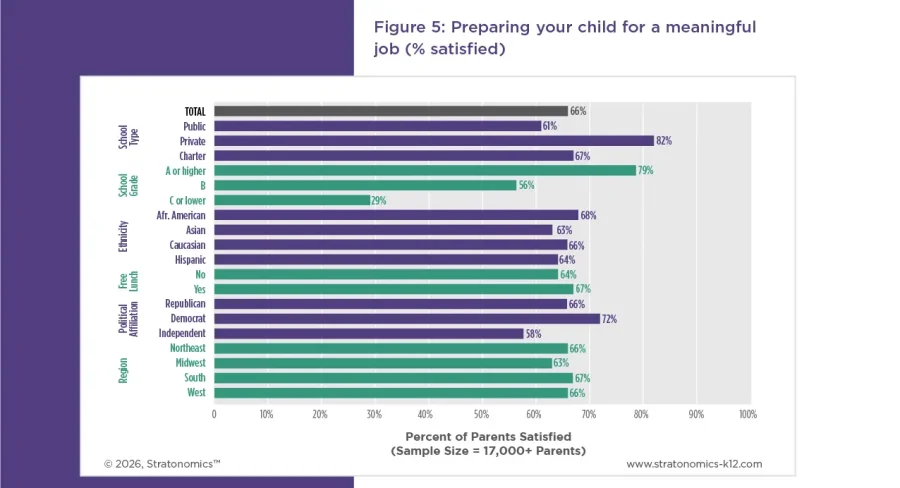
As shown in Figure 5, most parents (66%) are satisfied with the way their school is preparing [their] child for a meaningful job. Furthermore:
• Satisfaction is strongest among parents of students in private schools, followed by charter schools. Public school parents are least satisfied that the school is preparing their child for a meaningful job.
• Satisfaction is extremely strong among parents who grade their school A or higher. Satisfaction is somewhat lower among parents grading their school B and extremely weak among parents grading their school C or lower.
• Democrats have slightly higher satisfaction levels than Republicans.
• Access to free/reduced lunch has little impact on satisfaction.

The key takeaways from the Stratonomics-K12TM Strategy Science Study include the following:
• Parents are generally satisfied that their child’s school is preparing their student for the future. Specifically:
° Parents of private school students are most satisfied with their schools, followed by parents of charter school students.
° Public school parents have relatively lower satisfaction levels than their counterparts.
• Parents show mixed agreement that a 4-year college degree is essential for any child to be successful in the world. About half agree that a 4-year college degree is essential, while half do not. Furthermore:
° Agreement is higher that a 4-year college degree is essential among parents of private school students, schools graded A or higher, Asian and Democratic parents, and those whose students have access to free/reduced lunch.
° Parents in the Midwest are less likely to agree that a 4-year college degree is essential for success than are parents in other regions.
• Parents are more satisfied that schools are preparing their students for the next grade than for college or a meaningful job. Specifically, 79% of parents are satisfied that their children’s school is teaching [them] skills to succeed in the next grade, but only two thirds are satisfied that the school is preparing [their] child for college (66%) or preparing [their] child for a meaningful job (67%). Furthermore:
° Across the board, satisfaction is strongest among private school student parents, followed by charter school parents. Satisfaction is weakest among parents of children attending public school.
° Similarly, satisfaction is strongest among parents who grade their school A or higher, followed by those grading their school B. Those rating their school C or lower are least confident that the school is preparing their child for the future.
° Democrats are more satisfied than Republicans on each of the three dimensions.
° Few differences emerge based on ethnicity, access to free lunch, or region.
Insights from this report can inform school districts’ strategic planning by ensuring that they focus on curriculum that prepares children for the future, be it college or obtaining meaningful employment.
Mittal, Vikas (2026). “Learning, Jobs, and College Readiness: A
Parent Perspective,” Stratonomics-K12TM Strategy Science Study, 1-11.