© 2026 by StratonomicsTM. This document is licensed to be used only by permission from Stratonomics-K12TM. All information shared is copyrighted, proprietary, and confidential. Do not copy, record, share, store, distribute, use in language or learning models, modify content, use for teaching purposes without full attribution, assign as reading, transmit, or otherwise use in any capacity (e.g., corporate presentations or strategy planning) without express written permission and full attribution. Contact info@stratonomics.inc for rights and permissions.

www.stratonomics-k12.com

Stratonomics-K12TM Strategy Science Study

industry insights assets k12-50

Stratonomics-K12TM Strategy Science Study

Background

Special needs among schoolchildren range from learning disabilities to physical and developmental challenges. Children with special needs require investments in additional support so they can thrive academically, emotionally, and socially. To address the students’ needs, schools may implement Individualized Education Programs, adapt curricula using Universal Design for Learning, train teachers in differentiated instruction, and provide assistive services, among other approaches.

Children with special needs represent a significant and growing portion of the kindergarten through 12th grade (K12) population in the United States. In the 2022–23 school year, about 7.5 million students, or roughly 15% of public school students, received services under the Individuals with Disabilities Education Act, the federal mandate ensuring free and appropriate public education for eligible children ages 3 to 21 years. However, as of 2022, 67% of the special needs children spent more than 80% of their time in general school classes.

Schools face substantial challenges in serving special needs students. Specifically, a Government Accountability Office report found that only about 20% of students with disabilities attend schools with a full complement of support staff—such as counselors, social workers, psychologists, and nurses—reflecting potential staffing shortages and uneven resource distribution.

K12 leaders increasingly must account for the growing proportion of special needs students. They must also account for the views of the most critical stakeholders in schools: parents who entrust their children to their school districts. A customer-focused strategy enables educational institutions to identify the customer needs providing the most value to parents, align strategy execution to those needs, and ultimately improve customer loyalty and academic outcomes. Without a clear understanding of parents’ value drivers, school district strategies inevitably miss the mark, leading to declining enrollment and academic achievement.

www.stratonomics-k12.com

1

Stratonomics-K12TM Strategy Science Study

Research Methodology

Since 2022, the Stratonomics-K12TM Strategy Science Study has measured parents’ beliefs and attitudes about, as well as satisfaction with, their child’s education. The ongoing study measures parent satisfaction with different dimensions of K-12 education, along with their agreement with various statements about the school experience.

The report focuses on various aspects of schooling that affect special needs students. The results are based on responses from 17,700 parents of children in grades K through 12.

Stratonomics-K12™ measures parents’ beliefs and attitudes about, and satisfaction with their child’s education.

www.stratonomics-k12.com

2

Stratonomics-K12TM Strategy Science Study

industry insights assets k12-52

www.stratonomics-k12.com

3

Stratonomics-K12TM Strategy Science Study

industry insights assets k12-53

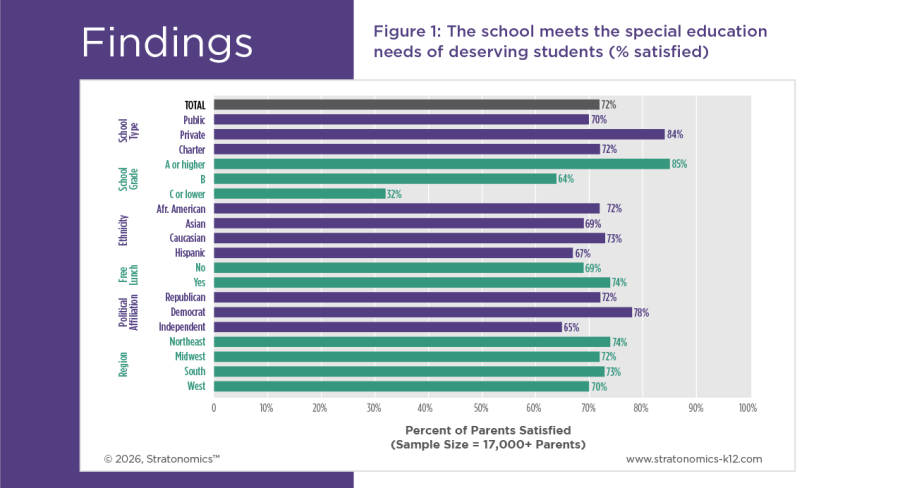
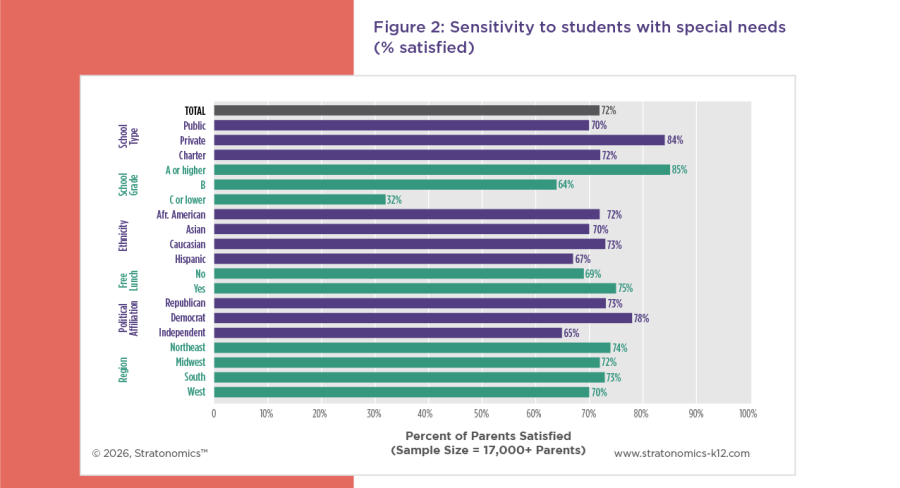
Figures 1 and 2 show parents’ satisfaction with two aspects special needs students in schools.

As shown in Figure 1, most respondents (72%) are satisfied that their child’s school meets the special education needs of deserving students. Furthermore:

  • Parents of students in private schools and schools they grade A or higher are most satisfied. Parents grading their schools C or lower are least satisfied.
  • Satisfaction does not vary significantly by ethnicity.
  • Parents of students having access to free/reduced lunch are more satisfied than are those whose students do not have access.
  • Democrats are somewhat more satisfied than Republicans and considerably more satisfied than Independents.
  • Region is not a major factor affecting satisfaction.

www.stratonomics-k12.com

4

Stratonomics-K12TM Strategy Science Study

industry insights assets k12-54

As shown in Figure 2, most parents (72%) are satisfied with their school’s sensitivity to students with special needs. Furthermore:

  • Satisfaction is strongest among parents of students in private schools and those grading their school A or higher and lowest among parents grading their school C or below.
  • Ethnicity has little impact on satisfaction.
  • Parents of students having access to free/reduced lunch are more satisfied than parents whose students do not have access.
  • Democrats are somewhat more satisfied than Republicans and considerably more satisfied than Independents.
  • Level of satisfaction does not vary significantly based on region.

www.stratonomics-k12.com

5

Stratonomics-K12TM Strategy Science Study

Key Takeaways

Most parents appear to be satisfied with the ability of their children’s schools to accommodate special needs students.

  • Parents are satisfied with the extent to which their children’s schools meet the special education needs of deserving students and have sensitivity to children with special needs.
    • Satisfaction with special needs issues is strongest among parents of private school students, those grading their school A or higher, and parents of students with access to free/reduced lunch.
    • Democrats are somewhat more satisfied than Republicans with the way their schools handle students’ special needs and considerably more satisfied than Independents.
    • Few differences are noted based on ethnicity or region.

Insights from this report reinforce the importance of providing deserving students access to special education and treating them with care and sensitivity, a critical consideration for school districts when implementing strategy.

www.stratonomics-k12.com

6

Citation

Mittal, Vikas (2026), “Parental Priorities in K12 Special Education,” Stratonomics-K12™ Strategy Science Study, 1-7.