
School choice—the ability of families to send their child to a school other than the public school to which they are zoned—has proliferated in the last decade. Nationally, 83% of students attend traditional public schools, while about 10% are enrolled in private schools and 7% rely on charter schools or other options.
A comprehensive review covering more than 100 rigorous empirical studies finds that school choice programs tend to improve academic outcomes, particularly when students remain in their chosen kindergarten through 12th grade (K-12) school for three to four years. Another review of over 60 studies finds that K-12 voucher, tax-credit, and savings-account programs yield increased high school graduation rates and college enrollment, with no credible studies showing overall negative effects for the core measurable outcomes. Some randomized-lottery studies in urban school systems do, however, find no measurable difference in traditional academic outcomes for those attending better performing schools via choice programs.
More and more states are adopting legislative policies promoting school choice. Alabama, Florida, Georgia, Louisiana, Oklahoma, and Utah enacted expanded voucher- and charter-school laws in recent years. Within the last several years, Texas, Arizona, and Iowa expanded their school-choice options via vouchers, education savings accounts, and charter-school legislation to broaden family access and reshape the K-12 landscape.
For school leaders, empirical findings provide important strategic direction. Implementing a strategy that accounts for school choice, will require K-12 leaders to account for the beliefs and opinions of the most critical stakeholders in schools: parents who entrust their children to school districts. A customer-focused strategy enables educational institutions to identify the specific needs that provide the biggest lift in overall value for parents, align strategy execution to those needs, and ultimately improve customer loyalty and academic outcomes. Without a clear understanding of parents’ value drivers, school district strategies inevitably miss the mark, leading to declining student enrollment and academic achievement.
Since 2022, the Stratonomics-K12TM Strategy Science Study has measured parents’ beliefs and attitudes about, as well as satisfaction with, their child’s education. The ongoing study measures parent satisfaction on different dimensions of K-12 education, along with their agreement with various statements about the school experience.
The study, based on survey responses from 17,700 parents of K-12 children, focuses on parents’ preference among public, private, charter, and other forms of schooling for their children.
Stratonomics-K12 measures parents’ beliefs and attitudes about their child’s education.


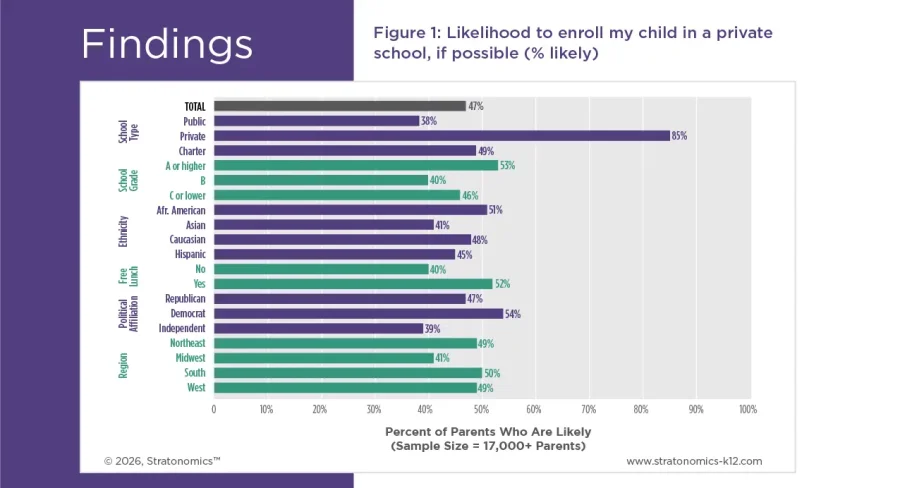
As shown in Figure 1, just under half of parents (47%) are likely to enroll [their] child in a private school, if possible. Furthermore:
• Likelihood is strongest among parents of students already enrolled in private school, followed by parents of charter school students.
• Parents of students in public schools are least likely to enroll them in private schools.
• Parents grading their school A or higher are more likely to enroll their child in a private school than those assigning their school a lower grade.
• Asian parents are least likely than those aligning themselves with other ethnicities.
• Parents of children with access to free/reduced lunch are more likely to enroll their child in private school than their counterparts.
• Democrats are more likely than parents of other political affiliations.
• Midwest parents are least likely to enroll their children in private school.
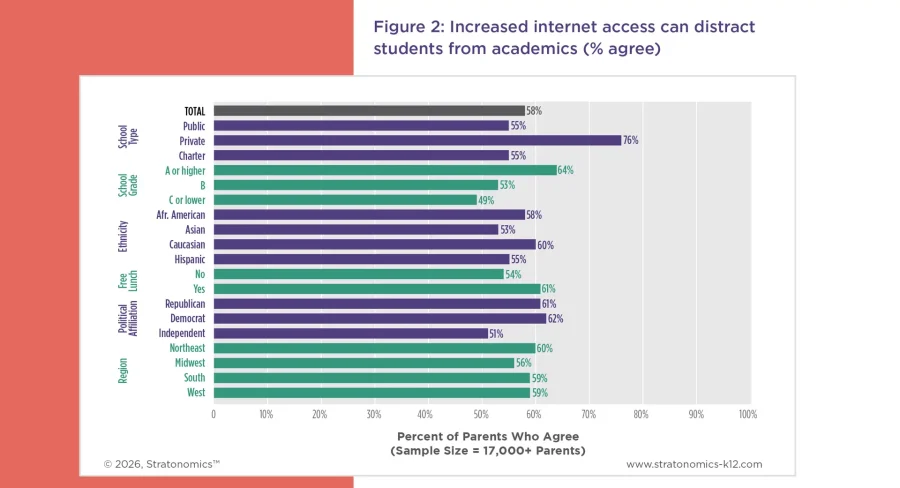
As shown in Figure 2, most parents (71%) agree that school choice helps increase the quality of education children receive. Furthermore:
• Agreement is strongest among parents of private school students (followed by those of charter school students).
• Parents grading their child’s school A or higher are more likely to agree.
• Ethnicity has little impact on agreement.
• Agreement is similar among parents of children having access to free/reduced lunch and those whose children do not.
• Agreement does not vary significantly between Democrats and Republicans.
• Region of residence has little impact on agreement.
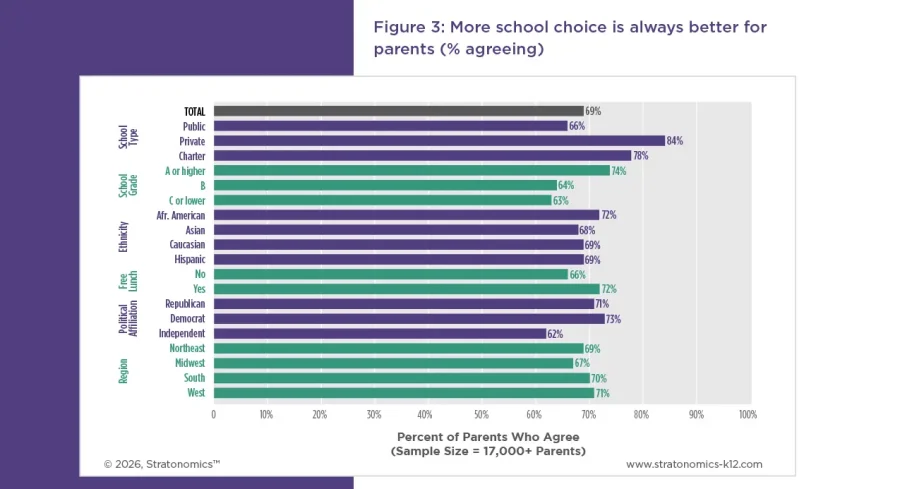
As shown in Figure 3, most parents (69%) agree that more school choice is always better for parents. Furthermore:
• Agreement is strongest among parents of private school students (followed by those of charter school students)
• Parents grading their child’s school A or higher are more likely to agree.
• Ethnicity has little impact on agreement.
• Agreement is slightly higher among parents of children having access to free & reduced lunch than their counterparts.
• Agreement does not vary between Democrats and Republicans.
• Region has little impact on agreement.
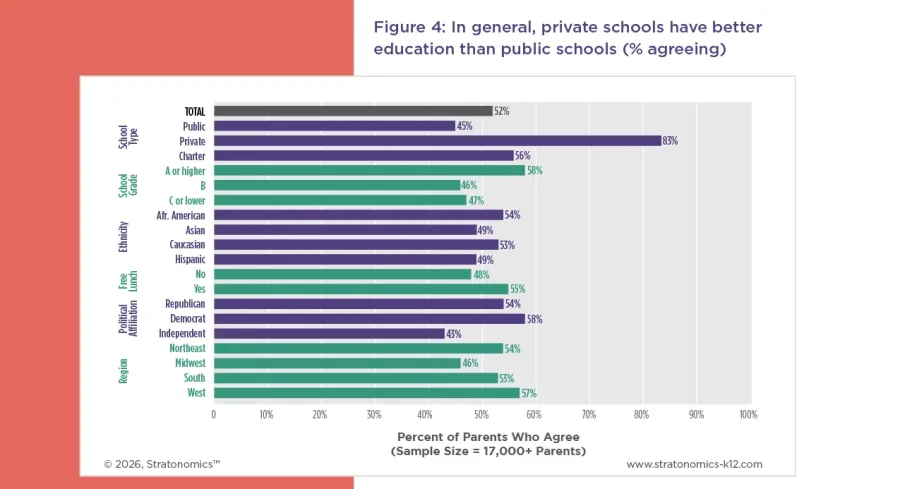
As shown in Figure 4, about half of parents (52%) agree that in general, private schools have better education than public schools. Furthermore:
• Agreement is stronger among parents of students in private (and to a slightly lesser extent charter) school than among parents of public-school students.
• Those grading their child’s school A or higher agree most strongly that private schools have better education than public schools.
• Parents of students with access to free/reduced lunch agree more strongly than those whose children do not.
• Ethnicity does not significantly impact agreement.
• Democrats and Republicans are similar in terms of agreement.
• Parents in the Midwest are least likely to agree that private schools provide a better education that public schools.
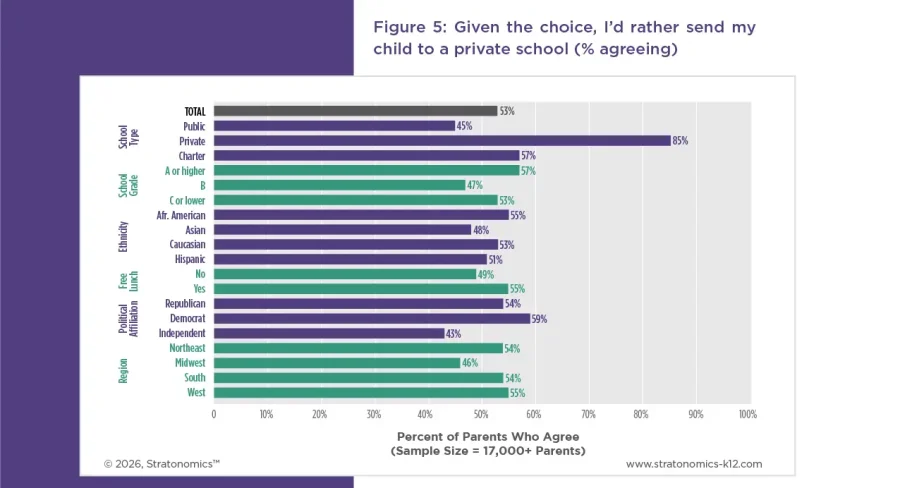
As shown in Figure 5, just over half of parents (53%) agree that given the choice, I’d rather send my child to a private school. Furthermore:
• By a wide margin, agreement is highest (86%) among parents already sending their children to private school.
• Parents grading their child’s school A or higher are more likely to agree than those grading their child’s school B. Parents grading their child’s school C or lower do not have substantially lower agreement than those grading their child’s school A or higher.
• Few differences emerge based on ethnicity.
• Parents of children with access to free/reduced lunch are more likely to agree than those whose children do not have access.
• Democrats are somewhat more likely to agree than Republicans.
• Those in the Midwest are least inclined to agree they would send their child to a private school, given the choice.
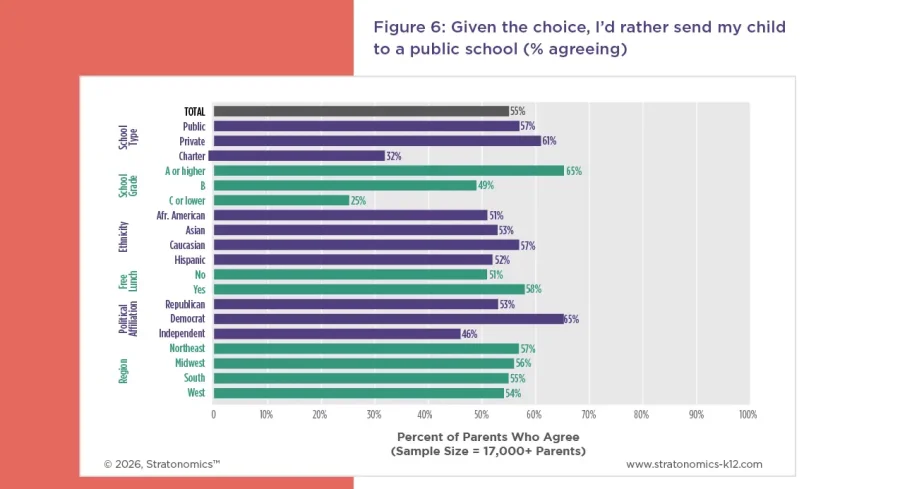
As shown in Figure 6, more than half of parents (55%) agree that given the choice, [they would] rather send [their] child to a public school. Furthermore:
• Agreement is strong among parents of public-school students, but it is also high among parents of private-school students.
• Parents grading their school A or higher strongly agree.
• Few differences emerge based on ethnicity.
• Having access to free/reduced lunch has a minor impact on agreement.
• Democrats express much higher agreement than Republicans and Independents.
• Agreement is similar across regions.
• Most parents agree that school choice can increase the quality of their child’s education—and that it is better for the parents themselves. Parents of existing private school students and those grading their child’s school an A or higher agree most strongly.
• Though private schools are rated more favorably than public schools overall, results are mixed when parents are asked about school choice. Notably:
° Fewer than half are likely to enroll their students in a private school, if possible. As expected, enrollment likelihood in private school is extremely high among parents of existing private-school students. It is also high among parents grading their school A or higher, Democrats, and parents whose students have access to free/reduced lunch.
° Similarly, just half agree that private schools provide a better education than public schools. Again, the appeal of private school is extremely strong among parents of children already attending private school, parents grading their school A or higher, and those whose children have access to free/reduced lunch.
° Interest in private schools is weaker in the Midwest than in other regions.
° About half of parents agree that, given the choice, they would prefer to send their child to private school and half agree that they would rather send their child to public school.
Insights from this report can facilitate school districts’ strategic planning process by informing administrators of the likelihood that parents may enroll their child in another school type. Competing on value using a science-driven strategy can mitigate the effect of school-choice driven student enrollment.
Mittal, Vikas (2026) “School Choice – A Parent Perspective,” Stratonomics-K12TM Strategy Science Study, 1-11.